
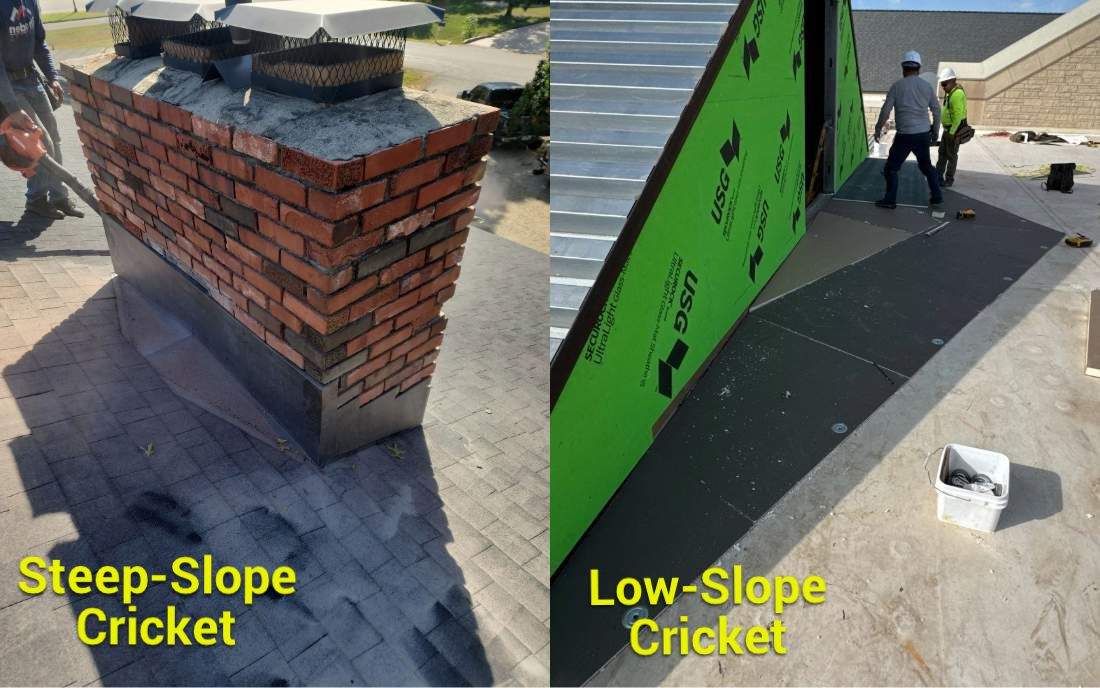
When Are Crickets Used in Roofing?
Crickets may be used on both steep-slope and low-slope roofsRoof Types - Low-slope roofs (flat roofs) are a type of roof system with less than a 3:12 pitch, most commonly found on commercial and industrial buildings. More to redirect water where the intended drainage path is obstructed. On steep-slope roofs, they are often found behind wide chimneys that would obstruct the flow of water; on low-slope roofs, they are commonly built with tapered insulationComponent - Tapered insulation is insulation manufactured with varying thicknesses to create slope and direct water across a low-slope roof. More to direct water toward drains or away from walls and curbs. Steep-slope crickets may either be one large piece of metal flashing or created by the framing of the house.
Most property owners hear the term during leak diagnostics or commercial roof replacement discussions. Roofs that cannot move water around a penetrationComponent - A roof penetration is an opening where something passes through the roof surface, such as a plumbing pipe or an HVAC unit curb. More naturally are likely to have a cricket. Without a cricket, water can sit against the upslope side of a penetration or collect in low areas on a low-slope roof.