
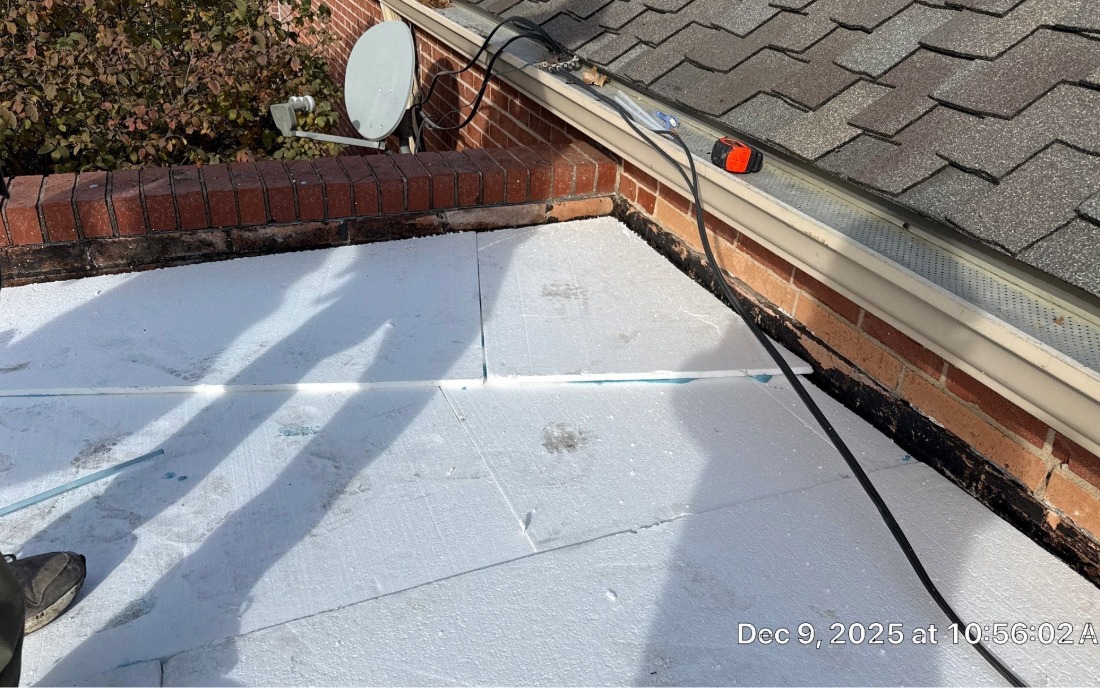
Why Tapered Insulation Is Used
Low-slope roofsRoof Types - Low-slope roofs (flat roofs) are a type of roof system with less than a 3:12 pitch, most commonly found on commercial and industrial buildings. More require positive slope to move water toward drains, scuppers, or gutters. That slope can be built into the structure itself (structural slopePerformance - Structural slope is the intentional pitch built into a roof’s framing or deck to direct water toward drains or roof edges. More) or created above the roof deckComponents - A roof deck is the structural surface connected to a building’s framing that supports the roof system installed above it. More with tapered insulation. Installed between the roof deck and membranePrimary Roof Covering - A single-ply membrane is a roof covering that uses one continuous layer of material to waterproof low-slope roofs. More, tapered insulation creates drainage by gradually changing thickness across the roof surface. Because insulation is already part of most low-slope roof systems, tapered insulation can provide drainage without affecting the building’s structure or overhauling the roof system’s design.
Tapered insulation may be installed across an entire roof or only in specific areas. It is commonly used to build crickets, improve drainage around curbs and penetrationsComponent - A roof penetration is an opening where something passes through the roof surface, such as a plumbing pipe or an HVAC unit curb. More, or correct localized pondingRoof Problems - Ponding water is accumulated water that remains on a roof surface for more than 48 hours after rainfall. More areas. On larger projects, tapered insulation systems are custom-designed and assembled across the roof like a jigsaw puzzle.