
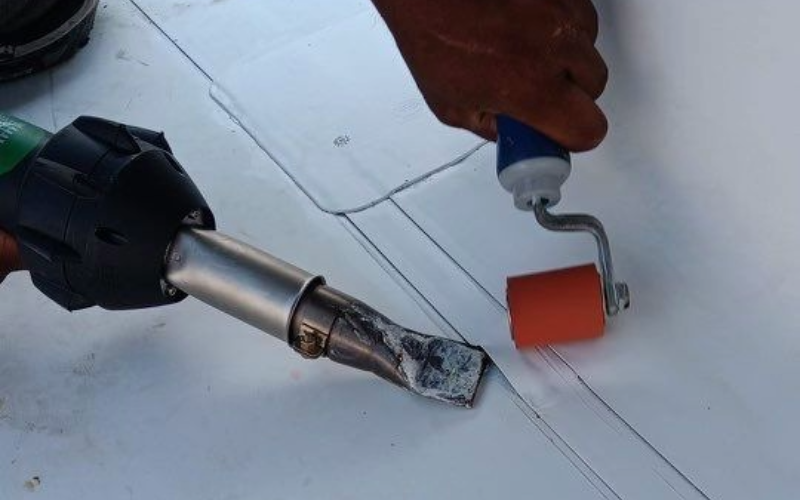
How TPO and PVC Become a Single Waterproof Surface
Heat-welded seams are a defining feature of TPOPrimary Roof Covering - TPO (thermoplastic polyolefin) is a white roof covering used on flat (low slope) roofs, commonly installed on commercial buildings to create a continuous waterproof surface. More and PVCPrimary Roof Covering – PVC (polyvinyl chloride) is a heat-weldable single-ply roof membrane used on low-slope roofs, particularly on buildings where grease, oils, or other chemicals may contact the roof. More roof systems. These membranes are manufactured in separate sheets, so the seams between them must be joined together to create a single waterproof layer across the roof.
Most roof replacement proposals involve heat-welded seams, since TPO and PVC are common membranePrimary Roof Covering - A single-ply membrane is a roof covering that uses one continuous layer of material to waterproof low-slope roofs. More choices. While EPDM uses tape or adhesives to join sheets, TPO and PVC fuse them together with heat welding followed by a roller to press the melted sheet edges together. The same process is used to secure membrane detail flashing.
Higher quality welds greatly increase the roof’s ability to keep water out. If the seam was not heated correctly during installation, it may separate over time, producing a cold weldRoof Problems - A cold weld is an area in a heat-welded seam that failed to fuse completely during installation. More.