
TPO ROOFING FOR LONG-TERM PERFORMANCE
We Stand Behind our Work for the LIFETIME of your Roof
Commercial Double-Lifetime Workmanship Warranty
Over 1,000 5-Star Google Reviews
Wichita's 2025 Small Business of the Year
TPOPrimary Roof Covering - TPO (thermoplastic polyolefin) is a white roof covering used on flat (low slope) roofs, commonly installed on commercial buildings to create a continuous waterproof surface. Read full article Roofs
Nearly 20 Years Designing & Installing TPO Roof Systems
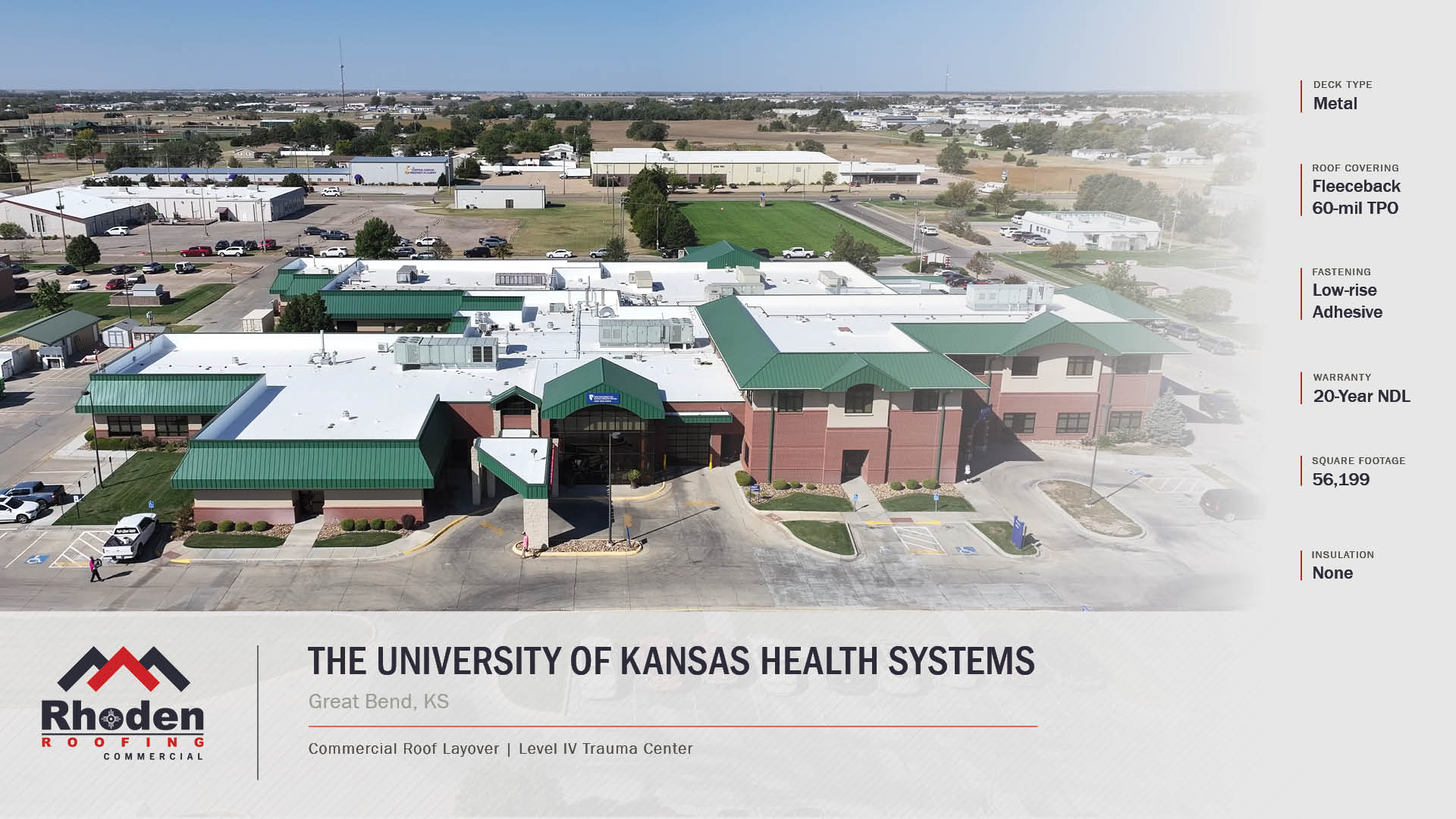
For a Level IV trauma center, a roof problem cannot become an operational problem.
After severe hail damaged The University of Kansas Health Systems in Great Bend, KS, building ownership needed a durable, cost-effective solution for its new, long-term tenant. The hospital needed confidence that patient care, staff, equipment, and emergency access would not be affected.
Multiple core cuts showed a modified bitumen system that was structurally sound enough to lay over, reducing costs and preventing the operational disruption of a full tear-off.
That discovery shaped the rest of the project. We coordinated with the hospital’s electrician to roof around helipad communication equipment in under two hours, planned around a network of HVAC equipment and active gas lines, and communicated with hospital staff daily.
Throughout the project, our goal was to provide the building with the roof it needed while the hospital continued to provide its patients with the care they needed. The project was completed five days ahead of schedule.
To learn more, see the NRCA’s profile on the project.
When pedestrians are looking down at their phones or at each other, even the threat of danger overhead is unacceptable.
The Fine Arts building at McPherson’s Central Christian College needed a new roof, but it didn’t need a liability. The safety of its students and their unimpeded movement were central to Central Christian College’s facility manager’s decision to choose Rhoden Roofing. This meant liberal use of caution tape, safety cones, and, most importantly, constant communication.
The telehandlerEquipment - A telehandler is a lift machine with an extendable boom that roofing crews use to load materials and manage debris around steep and hard-to-reach roofs. Read full article used to load material on the roof needed to ride over a concrete sidewalk. Our superintendent notified the facilities director that we were about to damage the sidewalk, blocked it off, and we paid to have the damaged sidewalk replaced within a week.
The Plumbers and Pipefitters Union purchased the former Toys “R” Us location off West Kellogg with a visible, aging roof.
Although the roof was more than 20 years old, it had not developed substantial leaks, making it a good candidate for a layoverInstallation – A layover (recover or overlay) is a method of installing a new roof membrane over an existing roof system without removing the existing roof. Read full article rather than a full tear-off.
During the pre-construction walkthrough, Rhoden Roofing identified an unusual risk: electrical lines less than an inch below the roof surface. Before work began, the lines were labeled, the crew was briefed and the roof layout was planned around them.
That plan shaped the installation. Induction-weld fastening points were mapped, with arrows directing placement across the roof to avoid hundreds of feet of electrical lines. The layout alone took a day and a half to configure.
Despite the unusual conditions, only one incident occurred. With an electrician on standby, power was restored within hours, limiting disruption for the Union and its students.
Interior leaks made the problem obvious. The challenge was replacing the roof without creating a new problem.
Berry Company’s White Star Bobcat Machinery facility received regular shipments of heavy machinery that involved three sides of the building. A single damaged machine would cost tens of thousands of dollars, so the project had to be planned around these shipments before the re-roof began.
We loaded all materials from the east side of the building, keeping equipment and debris away from delivery zones. To eliminate the chance of causing damage, crews roofed exclusively on weekends, completing the project over three weekends with large crews of 12-14 workers.
Because solar panels were planned from the beginning, the new roof had to be compatible with Berry Company’s energy investment. Saturated insulation was replaced only where needed, preserving good-condition insulation and reducing unnecessary costs while maintaining 20-year warranty coverage.
At Silgan Dispensing, a leak without downtime was costly. A leak with downtime would be catastrophic.
That reality shaped the entire project. The roof needed to be replaced without slowing the operation beneath it, which required careful staging, disciplined supervision and constant attention to how roof work might affect the facility below. On a 158,211-square-foot manufacturing facility, small oversights had the potential to become expensive problems.
Rhoden Roofing recovered the metal roof while working around Silgan’s operational and safety requirements. Heat-welded walkway pads and a yellow visibility strip 15 feet from the roof edge created defined movement paths across the roof, per Silgan’s requirements, to reduce liability overhead and protect the people maintaining the roof.
When Bradford Memorial Library began a full remodel, the roof had to be waterproof before work progressed.
With a concrete deck, the project required a fully adhered TPO system and a tapered insulationComponent - Tapered insulation is insulation manufactured with varying thicknesses to create slope and direct water across a low-slope roof. Read full article layout on the east side of the building to introduce proper slope.
The project’s timing added another consideration. Work began in August, when pedestrian traffic and public access required deliberate planning, communication, and attentive on-site supervision. One Rhoden Roofing project coordinator owned the project from planning to field oversight, aligning the project from estimate through completion.
Completed in 2014, the only reported issue came five years later — and it was traced to wear on an exterior wall, not the roof systemRoof Types - A roof system (roof assembly) is the entire series of roofing layers and components above the roof deck that work together to weatherproof the building. Read full article.
TPO ROOFING
What is TPO?
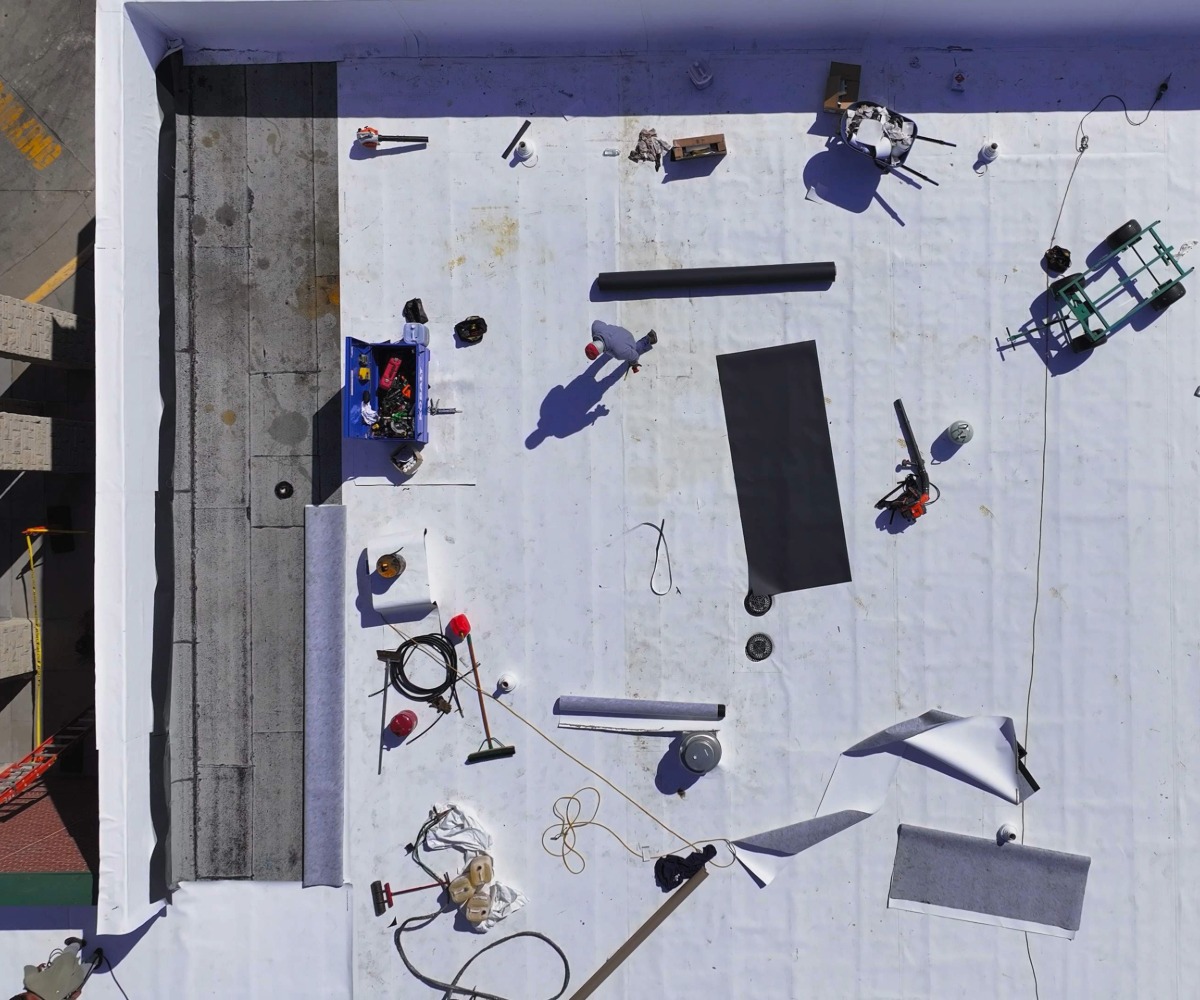
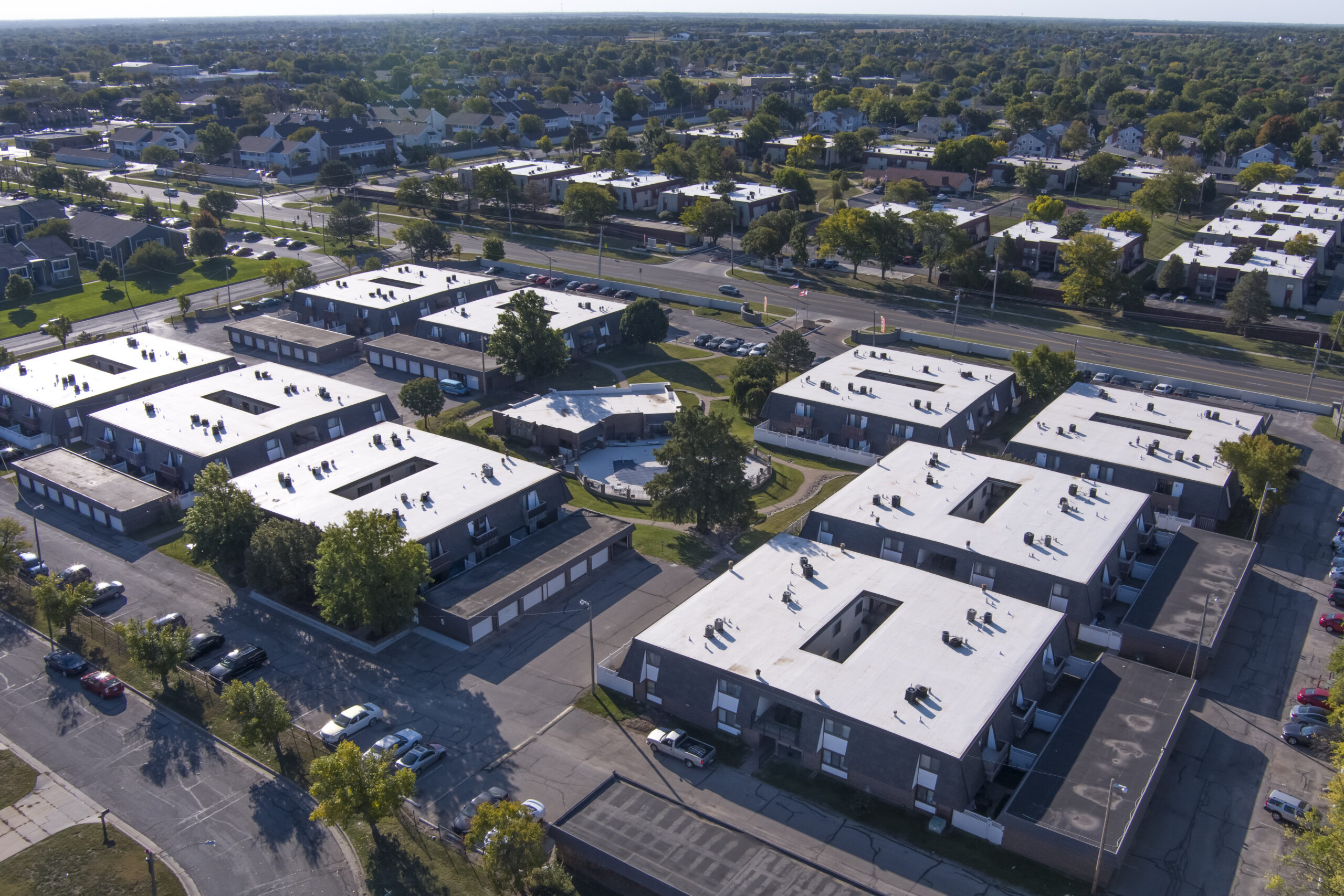
TPO is a white single-ply membranePrimary Roof Covering - A single-ply membrane is a roof covering that uses one continuous layer of material to waterproof low-slope roofs. Read full article used on low-slope roofsRoof Types - Low-slope roofs (flat roofs) are a type of roof system with less than a 3:12 pitch, most commonly found on commercial and industrial buildings. Read full article to create a waterproof surface. Its heat-welded seams, reflective surface and installation flexibility make it one of the most common commercial roof systems in the Midwest.
Not sure which roof covering is best for your property? We can inspect your existing roof system and outline the viability of TPO on your roof.
When TPO Makes Sense
TPO has become popular in the lower Midwest due to its reflectiveness, repairability, and installation flexibility. It is not the solution for every building, but it is often our go-to low-slope roof covering for commercial buildings.
Large Low-Slope Roofs
TPO is commonly used on large commercial roofs because wide membrane sheets and the option to mechanically attach make it economical at scale.
Energy-Efficient Surface
Its white surface reflects sunlight for years after installation, making it a common choice for building owners pursuing reduced energy costs.
Aging EPDM Roofs
TPO is often recommended when replacing an older rubber roof nearing the end of its service life.
Replacement or Recovery
TPO may be used when fully replacing or recovering a roof, but existing moisture and roof layers determine which solutions are possible.
TPO ROOFING
How We Evaluate a TPO Roof
Before recommending TPO or any repairs, we evaluate the system as a whole, the building’s use, and whether repair, replacement, or a hybrid approach will work best.

Address the Existing Roof System
We identify your existing roof system and diagnose any active leaks you may have.

Find Your Roof's 3 Factors
We determine your roof’s 3 factors: deck type, substrate condition and the number of roof layers.

Identify Your Building's Needs
TPO is not a one-size-fits-all solution. We make sure that TPO will meet your building’s needs.

Design a Scope for Your Building
Our scope is designed to fix the problem, align with your needs and meet manufacturer spec.
Low-Slope Membrane Comparison
TPO vs. PVC vs. EPDM
EPDM
A rubber membrane still found on many commercial roofs in the lower Midwest.
- Dark membrane surface
- Flexible material
- Often replaced with TPO at the end of its service life
TPO
A versatile membrane that performs well on most low-slope roofs.
- Highly reflective white surface
- Heat-welded seams
- Used as a retrofit material over many existing roof systems
PVC
Often the better fit when the building exhausts grease or chemicals.
- Chemically resistant
- Heat-welded seams
- Common on restaurants, industrial and manufacturing buildings
Frequently Asked Questions (FAQ)
How much does a TPO roof cost?
A standard 10′ x 100′ roll of 60-mil TPO costs about $1,000, not including labor. However, a TPO roof system includes the full roof assembly, including insulation, cover board, attachment method, metals and roof access — much more than just the membrane. Most TPO roof systems cost between $8 and $18 per square foot as a result. The more complicated the roof is, the more expensive the project will be. A roof with dozens of roof-mounted HVAC units, pipes and skylights will cost more to replace than an equal-sized roof with no penetrationsComponent - A roof penetration is an opening where something passes through the roof surface, such as a plumbing pipe or an HVAC unit curb. Read full article.
How long does a TPO roof last?
According to the NRCA, the average unmaintained low-slope roof has a service life of 10-14 years. A maintained roof often lasts nearly twice as long. In our experience, a properly installed TPO roofs can last up to 25-30 years when minor issues like small membrane tears and deteriorated sealant are addressed before they result in leaks.
Can a TPO roof be installed over an existing roof?
Yes, and it’s commonly done on roofs that are relatively healthy as they near the end of their service life. Also known as a layover, installing TPO over an existing roof eliminates the operational disruption and cost associated with tearing off the existing roof. There are two prerequisites for a layover.
- No more than one existing roof layer.
- Healthy, dry substrate.
If your roof meets those conditions, it may be eligible for a layover.
For more information, we compare a layover against a complete replacement in our article Layover vs Remove-and-Replace On a Membrane Roof: When Does it Make Sense?
Work With a Team of Roofing Professionals
You Can Trust
Our pride in workmanship on every project assures we only use the best materials and products. Your project will be completed to your 100% Satisfaction. No excuses.
We stand behind our work for the LIFETIME of your roof.