
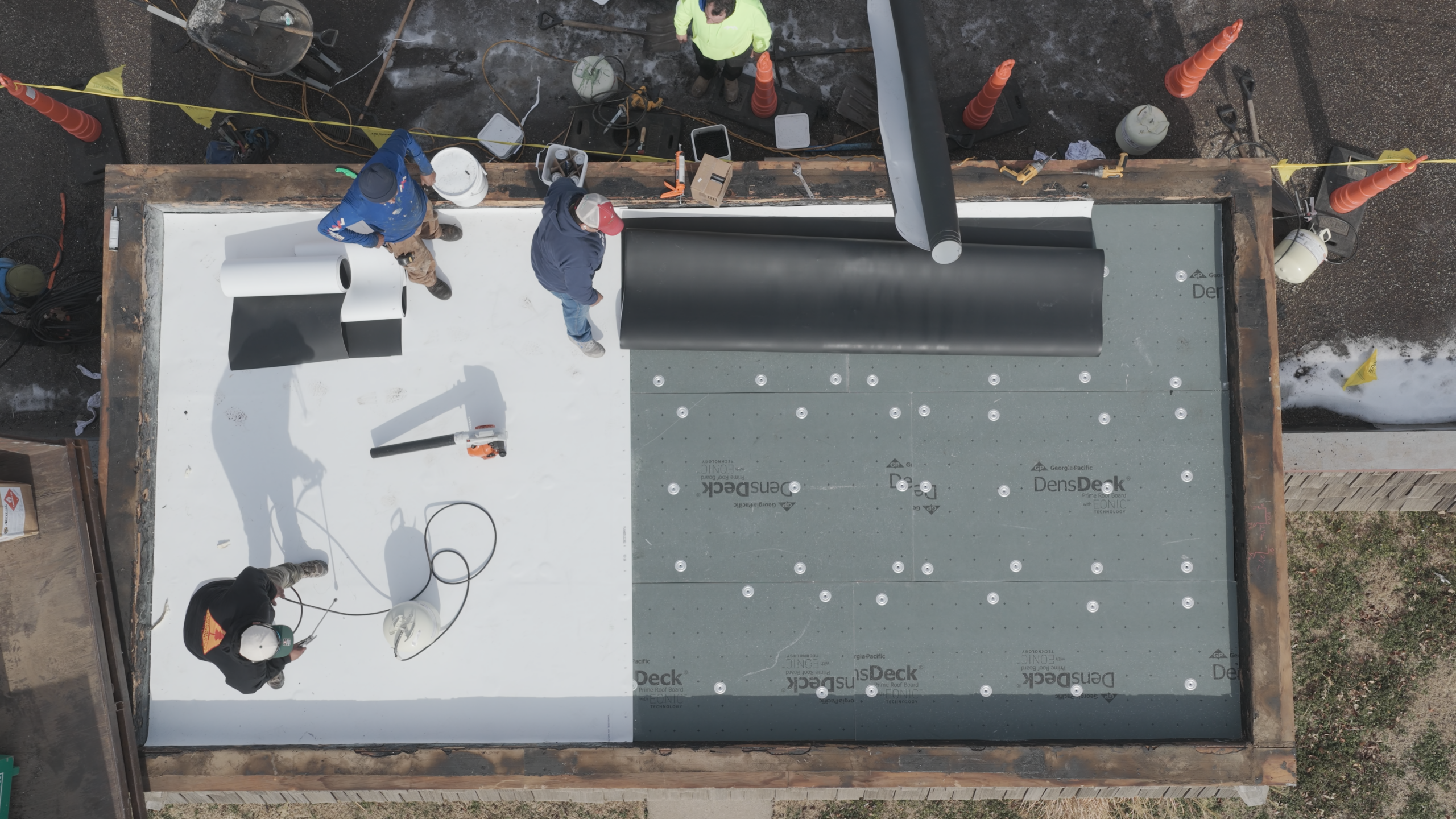
Why Single-Ply Membranes Are Used on Low-Slope Roofs
Low-slope roofsRoof Types - Low-slope roofs (flat roofs) are a type of roof system with less than a 3:12 pitch, most commonly found on commercial and industrial buildings. More drain water much more slowly than steep-slope roofs, so their coverings must be waterproof rather than water-shedding. Single-ply membranes create this waterproof layer by sealing reinforced sheets together at their seams, creating a continuous sheet over the roof.
Single-ply membranes are the most common type of roof covering for low-slope commercial buildings. Unlike traditional low-slope systems such as built-up roofing or modified bitumen, which rely on multiple layers, single-ply systems use one reinforced membrane layer as the primary waterproofing surface.
These membranes are widely used on commercial buildings because they are lighter and faster to install than many multi-layer roof systems.
Common types of single-ply membranes include TPOMaterial - TPO (thermoplastic polyolefin) is a white roof covering used on flat (low slope) roofs, commonly installed on commercial buildings to create a continuous waterproof surface. More, PVC, and EPDM.