What Homeowners Should Know About Steep-Slope Roof Replacements
Roofs come in all shapes and sizes, but slope dictates almost everything about the installation process – no matter the size. If a roof’s shape involves a pitch of 8:12 or greater, the installation process changes. Walking down a 10:12 roof is like walking down a playground slide – gravity is a constant hazard.
According to the NRCA, a “steep slope” roof is any roof exceeding 3:12 in pitch. When “steep” is used in this article, it refers to roofs that have a pitch of 8:12 or greater. This is the threshold at which gravity begins to dictate how materials and debris behave on a roof, and where safety systems and methods change in noticeable ways.
Note on Steep Roof Labor Pricing: Our labor costs increase at 7:12, 9:12, and 12:12 pitches to reflect changes in work pace, safety requirements, and risk. These thresholds are based on feedback from our crews, who we have worked with for nearly a decade. This may not be reflective of all roofing contractor pricing practices, however.
See What Affects the Cost of a Roof Replacement? Key Factors Explained to learn more about a roof pitch’s influence on the cost of replacing it.
Why Steep Roofs Require Special Equipment and Planning
On a 4:12 roof, friction helps you maintain stability. A 4:12 pitch has an angle of approximately 18 degrees, which is only 5-10 degrees steeper than most residential driveways – stable enough to walk across without constantly fighting gravity, especially with coarse granules creating friction underfoot. On a 10:12 roof, gravity overpowers friction and everything starts to slide down. Without proper safety measures, everything from people, tools, and shingles will fall in the direction of the slope it’s on: down.
This dramatically affects the installation process:
- Crews can’t stand comfortably without assistance.
- Roofing materials can’t just be set down: they need to be secured.
- The crew must actively control the descent of debris rather than simply tear it off and set it down until it can be brought to the dump trailer or Equipter.
- Safety features are necessary to walk and work, rather than just necessary for OSHA compliance.
Gravity remains in charge unless we implement systems to supplant it.
Safety Measures Required for Steep-Slope Roofs
While gravity can’t be circumvented, its perils can be combatted by taking proper safety measures throughout a roof replacement.
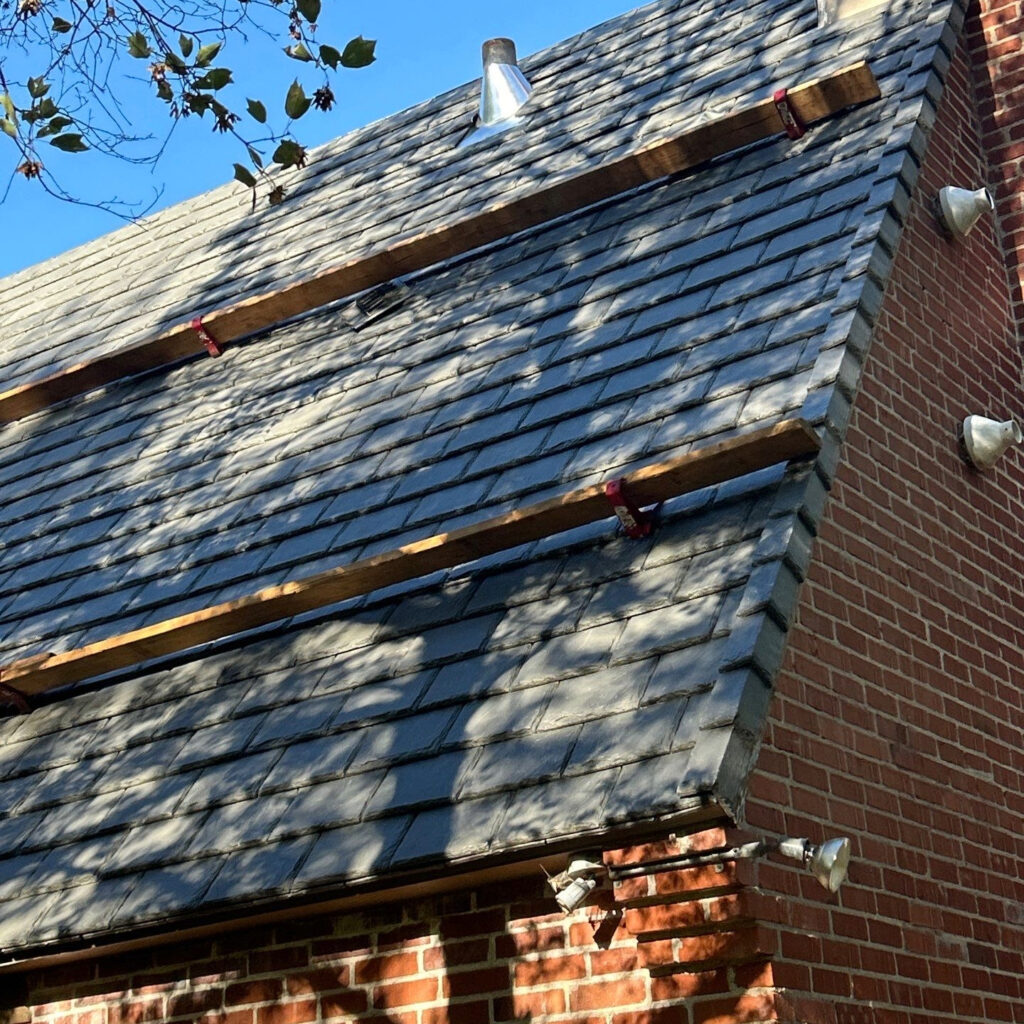
On steep-slope DaVinci roofs, roof jacks and planks create temporary, level platforms that allow crews to work without relying on friction alone. On DaVinci slate roofs like this, there’s not much friction to begin with, making roof jacks and planks especially important
Roof Jacks and Planks on Steep Roofs
Roof jacks are adjustable mounting brackets that support a plank (typically a 2×4 plank), allowing both people and material to stand and maneuver on a steep roof.
Roof jacks and planks have three uses on a steep roof.
-
- Material Staging: Material is typically staged on roof jacks and planks near the ridge, where it can be safely accessed when needed by the crew.
- Stable Working Surface: Roofs 10:12 or greater are virtually impossible to walk on. Roof jacks with 2×4 planks turn slopes into a series of temporary steps that allow the crew to work on a stable surface.
- Debris Management: Roof jacks and planks can be placed a foot up the eaves to prevent debris from accelerating directly onto gutters or, if the gutters have been removed, onto the property below.
Most roof jacks can be adjusted to support a level plank on roofs sloped up to a 45-degree angle (12:12). They are typically fastened directly to the rafters for stability. If you have a steep slope and hear especially loud banging after tear-off, it’s likely from roof jacks being hammered in to your rafters.
What homeowners should expect:
You’ll see horizontal planks running across sections of the roof, most likely near the ridge and at the eaves. These planks may be installed, uninstalled, and reinstalled elsewhere as your roof is installed, which will produce loud hammering.
Harnesses and Anchor Systems
Harnesses are required by OSHA when crews are working six feet or higher off the ground and required by gravity when working on any pitch past 8:12. The crew will install anchors at the ridge and attach them using a rope onto their arresting harnesses.
As a roof’s pitch increases, gravity makes balance unreliable without anchoring systems. Similar to roof jacks, anchors are typically fastened into structural members for added stability.
What homeowners should expect:
Crew members may be visibly tied off at the ridge of the roof and reposition their attachment throughout the project.
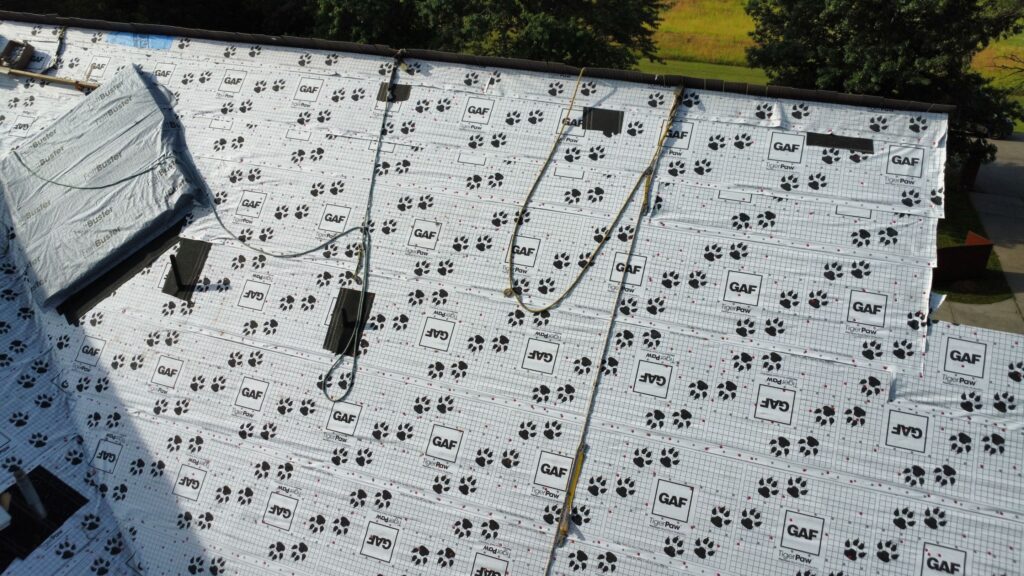
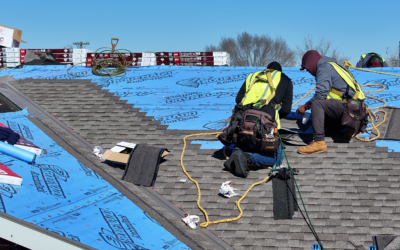
High-friction synthetic underlayment (GAF Tiger Paw, in this case) provides traction on steep slopes where gravity overpowers friction, which provides stability on shallower slopes. Harnesses here are anchored at the ridge, allowing the crew to safely maneuver the roof. This combination of traction underfoot and arresting harnesses anchored overhead prevents gravity from stopping a roof replacement.
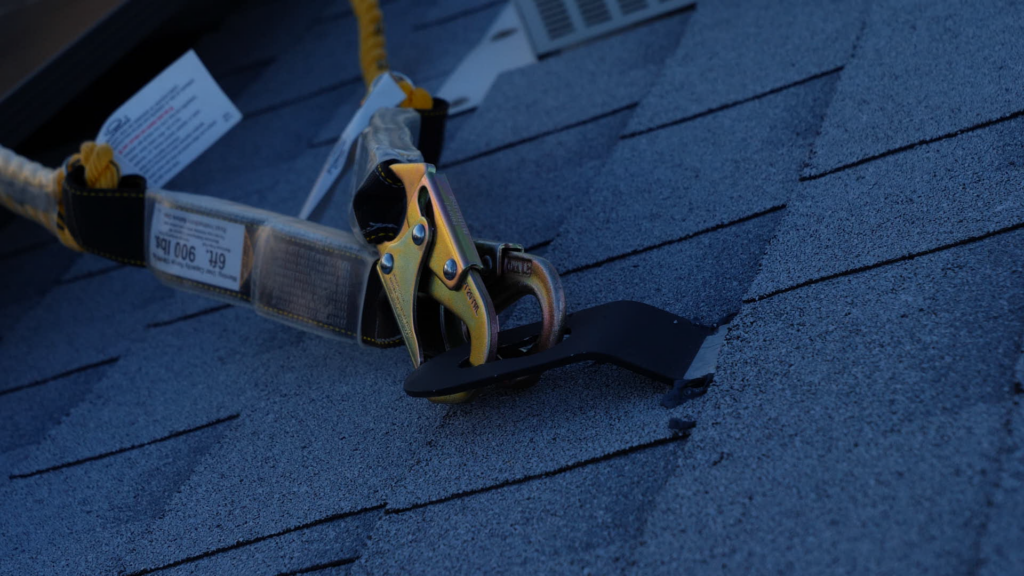
Roof anchors are fastened into structural members beneath a course of shingles to secure tie-off points for harness systems. In this image, anchors were used to complete a repair, not a replacement. This meant that the crew anchored the system on the field of the roof rather than the ridge, which may have required them to fasten through ridge caps or the top course of shingles to reach a structural member.
High-Friction Underlayment on Steep Roofs
We require high-friction underlayment, like GAF’s Tiger Paw, on steep roofs. This is an extra cost, since Tiger Paw is nearly 3x as expensive as GAF’s FeltBuster – our preferred underlayment. This has nothing to do with our warranty, and while it’s a premium product, even its enhanced performance isn’t the reason we require it on steep roofs. It’s simply safer. Underlayment is slick underfoot, similar to tarp. Tiger Paw is coarse and frictional, which prevents our crews from getting injured and allows them to work more efficiently.
Without high-friction underlayment, roofing crews would have difficulty accessing gable ends, dormers, and other slope transitions where roof jacks can’t be used.
What homeowners will notice:
A steep roof is more expensive to replace than a shallow roof of the same size, and underlayment is one of many reasons why. You will likely notice a more expensive roof as a result. If you see the crew walking semi-comfortably up a 10:12 slope after underlayment has been installed, it’s not a Michael Jackson music video reproduction – it’s traction produced by high-friction underlayment.
Foam Pads and Pitch Hoppers
What Are Pitch Hoppers?
Pitch hoppers are portable, metal steps that temporarily attach to the roof surface using friction. They have a foam base that creates friction force with asphalt shingles, keeping the foothold in place. Unlike roof jacks, which create continuous platforms along a slope, pitch hoppers are small footholds used for quick tasks or detail work on steep slopes. They can also be used to hold equipment while performing detail work.
What homeowners will notice:
Pitch hoppers look similar to louvered vents and are temporarily placed on shingles at various stages of installation, then simply lifted and removed when that section is complete. If your existing shingles are aged and degranulated, a pitch hopper can’t be used since granules produce the friction force that keeps the pitch hopper in place.
What Are Foam Pads in Roofing and Why Are They used?
Foam pads are dense cushions used to improve traction and comfort while performing detail work during a roof replacement.
On steep roofs, crews spend more time kneeling or bracing while working than on shallow roofs. Foam pads increase their stability and comfort while doing so.
When performing repairs, foam pads are also used to prevent damage to both the existing shingles and the repair crew. Asphalt shingles can reach temperatures up to 160 degrees Fahrenheit in the summer. At these temperatures, twisting your foot to turn around on a roof can cause degranulation, deep impressions in the asphalt, or tears.
What homeowners will notice:
Foam pads may be placed on the roof near ridges, valleys, or other flashing details. They are also commonly used to protect landscaping or hardscaping (e.g., AC units and patio decks) below.
Equipment Used for Steep-Slope Roof Replacement
To install an especially steep roof, the equipment used must be accessible (i.e., not excessively difficult to obtain or use, which would make scheduling roof replacements or finding labor prohibitively difficult), safe, reliable, and OSHA compliant.
Telehandlers for Material Loading on Steep Roofs
A telehandler is essentially a forklift with a telescoping boom arm. On steep roofs, it allows roofing crews to safely handle and load material.
When the pitch is too steep for the distributor to roof load material, we use a telehandler. Hand-loading (carrying material up a ladder) is dangerous even on flat roofsRoof Types - Low-slope roofs (flat roofs) are a type of roof system with less than a 3:12 pitch, most commonly found on commercial and industrial buildings. More. On steep roofs, it’s categorically not an option.
A telehandler allows us to:
- Lift shingles directly to the ridge, where they can be placed safely without sliding down.
- Suspend material within arm’s reach until it is needed.
- Prevent hand-loading.
What homeowners will notice:
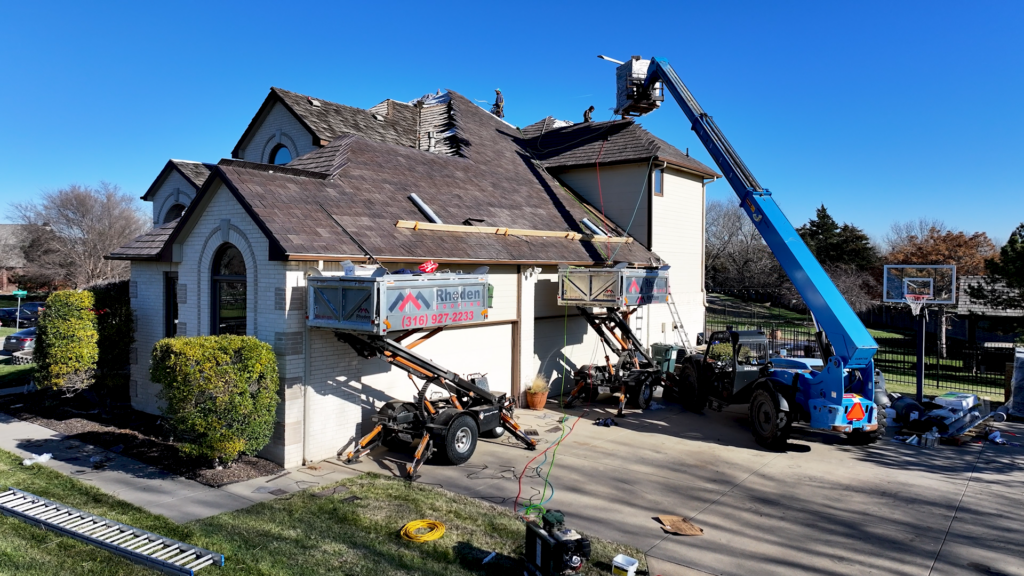
You may see a Telehandler positioned in the driveway near the house after tear-off has been completed and material is being loaded on the roof. Before beginning a roof replacement, we always consult with the homeowner about special property protection considerations, timelines, and where vehicles should be parked.
Equipter for Debris Management and Material Loading
The Equipter is a mobile, hydraulic lift trailer designed to abut or sit under the roofline. Equipters serve two roles: material loading and debris management.
On steep roofs, it’s especially important to manage gravity’s effects on debris. Debris doesn’t drop straight down – it slides down and accelerates on the way. A well-positioned Equipter catches this debris before it touches the ground.
See What Does Cleanup Look Like After a Roof Replacement to learn more about how Equipters manage debris.
Similar to a telehandler, an Equipter can be used to load material when the distributor can’t roof load. It can lift up to two pallets of material to the roofline, allowing crews to move bundles short distances rather than carrying them up steep slopes.
Without safety systems like roof jacks and 2x4s and planks, carrying material from the roof’s perimeter toward the ridge is unsafe. Even with those systems in place, we attempt to minimize the need to carry material across the roof if possible to reduce risk and fatigue.
- Equipters are even more useful for debris management on steep roofs (8:12 or greater) than they are on standard sloped roofs (3:12 – 6:12) because gravity is antagonistic on steep roofs. The debris will accelerate down steep slopes, and the Equipter can catch it before it hits the ground.
- When diagnosing roof leaks, we advise our team to “think like water” then ask, “Where would water flow?” When tearing off a roof, we think like debris: where would debris go? Answering this question tells us where to place an Equipter to catch most of the material that’s torn off.
- Because Equipters have hydraulic lifts, they can be used to safely load material on steep roof slopes that are under 15 feet tall.
What homeowners will notice:
If an Equipter is on-site for your roof replacement, it will first be used to safely deposit torn off roofing material directly at the roofline. Material will slide into it, along with being placed directly into it. Second, it will be loaded with material – up to two pallets worth – and again lifted to the roofline, where the crew can access the material without hand loading it.
Note: Equipters are not used in wet grass to avoid creating ruts. If it rained the previous day or your sprinkler system activates in the morning, we may be prevented from using an Equipter altogether.

How Roof Pitch Affects Property Protection
For an exhaustive overview of property protection practices, see our article covering cleanup after a roof replacement.
On steep roofs, protecting the ground below requires extra considerations, just like protecting the crew above. Here are the main ways that steep roofs affect property protection during a roof replacement.
- Gutters and gutter guards are much more likely to get damaged when replacing a steep roof. Removed shingles accelerate quickly down-slope into the gutters. For warrantied gutter guards, we recommend the installing company remove them to prevent your warranty from being nullified.
- The existing gutters may temporarily removed if the pitch is exceptionally steep, since debris may crash into and damage them.
- The Catch-All is effective at managing debris, but it doesn’t resist impacts like foam pads or sheets of OSB. On steep roofs, a “tent” of OSB is more likely to be used to protect windows or siding below than on shallow roofs.
- On steep roofs, debris doesn’t fall down a roof: it flies. This means that exterior light fixtures, such as those lining a porch walkway or the driveway, may be protected with a Catch-All mesh covering system if wind is liable to blow high-speed debris that direction.
Conclusion: What to Expect on a Steep Roof Replacement
Steep slopes change more than the aesthetic of a home – they change how a roof behaves during a replacement.
Gravity dictates where and how people can stand, where materials can rest, how debris moves, and how the property below is protected. As pitch increases, roofing becomes less about walking and more about systems: systems to create footing, systems to control movement, and systems to manage debris before it reaches the ground.
If your roof is especially steep, you should expect:
- More visible safety equipment.
- More deliberate material staging on the roof.
- More time spent on setup and property protection.
These differences do not represent a complication for an experienced roofing contractor. They’re just a natural response to physics.
If you have questions about what’s needed to replace your steep roof, call Rhoden Roofing at (316) 927-2233. We will prepare a free estimate for you and walk you through any questions you may have.