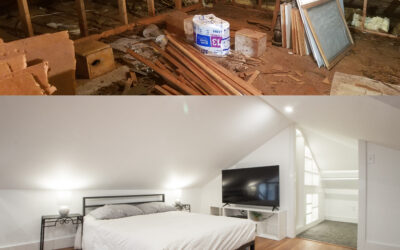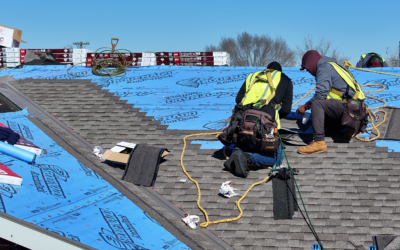
Over ten thousand nails and two tons of debris are removed from a roof during a replacement. If one nail is left in the driveway, it can cause hundreds of dollars in damages and make you late for work, neither of which contributes to 100 percent customer satisfaction. Our goal is to make sure that the only reminder you have that your roof was replaced is your new roof, not finding debris or nails in your yard for the next year.
While post-installation cleanup is critically important, a project’s cleanup is equally affected by preparation before the first shingle comes off.
Imagine that someone dumps a bucket of sawdust on the floor and tasks you with cleaning it. Cleanup would be time intensive, and residual sawdust would be everywhere. Now imagine I warn you ahead of time. This allows you to prepare: you can lay a tarp, place a bucket of your own to catch it, and move furniture. That’s why we prepare a property to handle the debris that comes off the roof. We scheduled it. We know that two tons of debris and 10,000 fasteners are coming off the roof. There’s no excuse not to prepare and minimize the chances of leftover debris.
Preparing Your Property for a Clean Roof Replacement
See this overview covering how to prepare your home for a roof replacement.
This section covers how we prepare your home for a roof replacement.
Preparation is the foundation of a clean jobsite. If your roofing contractor won’t take accountability for the nails in your driveway, nobody will. We prepare the property so debris is controlled from the moment tear-off begins, not cleaned reactively at the end of the day.

An Equipter hydraulic lift trailer is elevated to the roofline so debris can be placed directly inside instead of falling into the yard. This significantly reduces jobsite mess and prevents most nails and shingles from reaching the landscaping. The debris that falls lands directly on tarps, which are used to protect landscaping that doesn’t require the breathability of a mesh system, that are cleared throughout the project.
How Equipters (Hydraulic Lift Trailers) Reduce Debris During Tear-Off
An Equipter is a brand of drivable hydraulic trailers that are positioned directly under or abutting the edge of the roof. It’s a raised dumpster: debris is torn off the roof and placed directly into the Equipter rather than scattering in the air.
This makes it easier for the crews to clean while they work. Rather than allowing debris to accumulate on the roof or carry it to the dump trailer, they can drop it directly into a dumpster at the roofline.
Equipters are also designed to minimally impact the yards they often drive through. They have extra-wide tires so their 4,000-pound weight is spread out, reducing the pressure on your yard, more like a snowshoe than a stiletto.
Most debris is placed in the dump trailer, usually located in the driveway. An Equipter can either be a) an alternative to a dump trailer for properties with vulnerable or otherwise inaccessible driveways, or b) to complement a dump trailer and prevent the need for debris to be carried great distances across the roof for disposal.
When most debris is placed directly into a raised container instead of the landscaping, cleanup is no longer a recovery mission. However, if the yard is saturated from rain, we may avoid driving the Equipter on grass to prevent potential rutting.
Debris Management With On-Site Dump Trailers
Nearly every roofing project industry-wide uses a dump trailer to dispose of debris from the roof. It’s typically backed up to the garage on the driveway so the crew can drop material directly inside. We ask homeowners to remove any vehicles from the driveway and garage so that we don’t impede vehicle access during the project; however, if the homeowner requests that we avoid using machinery or the dump trailer on the driveway, we use the Equipter as the primary debris disposal method rather than a complimentary disposal method.
When tarps and Catch-All meshes are cleared during the project and at the project’s conclusion, all debris is loaded into the dump trailer.

The Catch-All mesh is set up vertically along the garage wall to prevent debris from hitting the siding or garage door. This homeowner had recently repaved their driveway, so the dump trailer was not backed up to this garage.
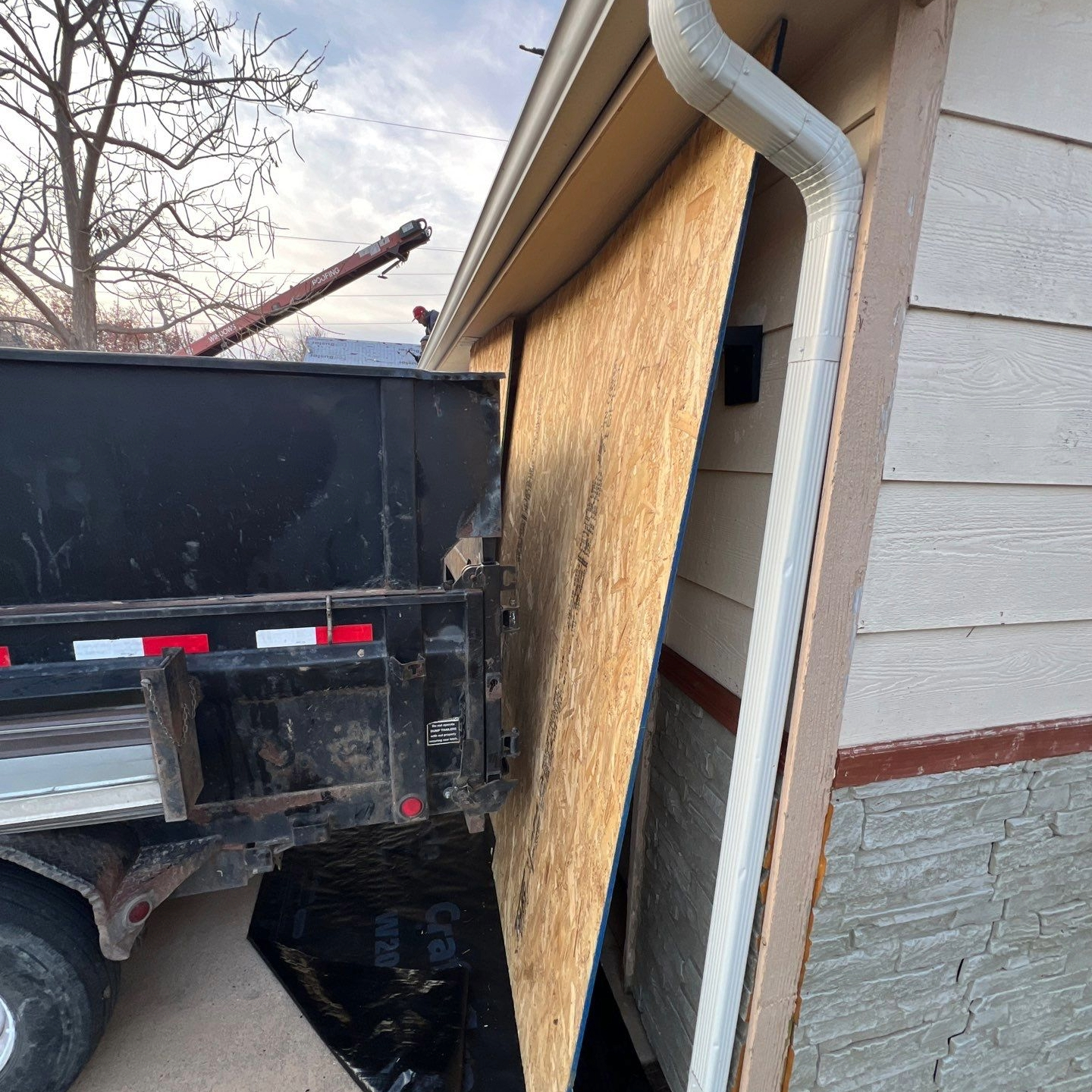
A sheet of OSB is temporarily braced against the garage to protect the door, siding, and exterior lights from falling roof debris. The dump trailer is backed directly against it, allowing crews to remove shingles without damaging vulnerable areas near the driveway.
Mesh Protection Systems for Nails and Other Debris
The Catch-All is a breathable, mesh safety net for your property. We place it along the perimeter of your house (e.g., mulch beds, rock beds, decks, and foliage) where nails or small shingle pieces are liable to disappear. It can also be laid over grass that’s near the home to prevent debris from ever touching the yard directly.
An Equipter catches heavy debris, while mesh coverings catch small debris that can slip through the cracks. Unlike a tarp covering, the Catch-All’s mesh is breathable, preventing heat-related damage to plants or grass on the property, which should always be covered.
Using OSB to Protect Vulnerable Areas on the Property
Some parts of a home need more rigid protection than a mesh can provide. OSB (engineered wood panels used as the roof deckComponents - A roof deck is the structural surface connected to a building’s framing that supports the roof system installed above it. More for most homes) is placed over vulnerable surfaces that could crack, dent or shatter if debris lands on them. Its rigidity allows impacting materials to distribute their force across the sheet of OSB rather than the vulnerable surface below.
These vulnerable areas include: 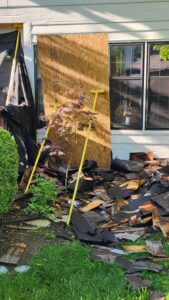
- Windows under steep slopes with minimal overhang. OSB leans against the house, covering the window and diverting debris into the mesh below.
- Egress window wells and plastic window covers. The window well is covered by OSB, preventing debris from entering or damaging the plastic cover.
- Garage doors. The dump trailer for loading debris is typically backed up to the house on the driveway. We use both OSB and a Catch-All mesh covering to protect garage doors from any stray debris.
- AC units. AC units are one of the most common sources of collateral damage during a roof replacement. Driving over a nail may cost a few hundred dollars to address; a few nails in an AC unit can cost thousands of dollars to address. Nothing requires more redundancies to protect than an AC unit. We use:
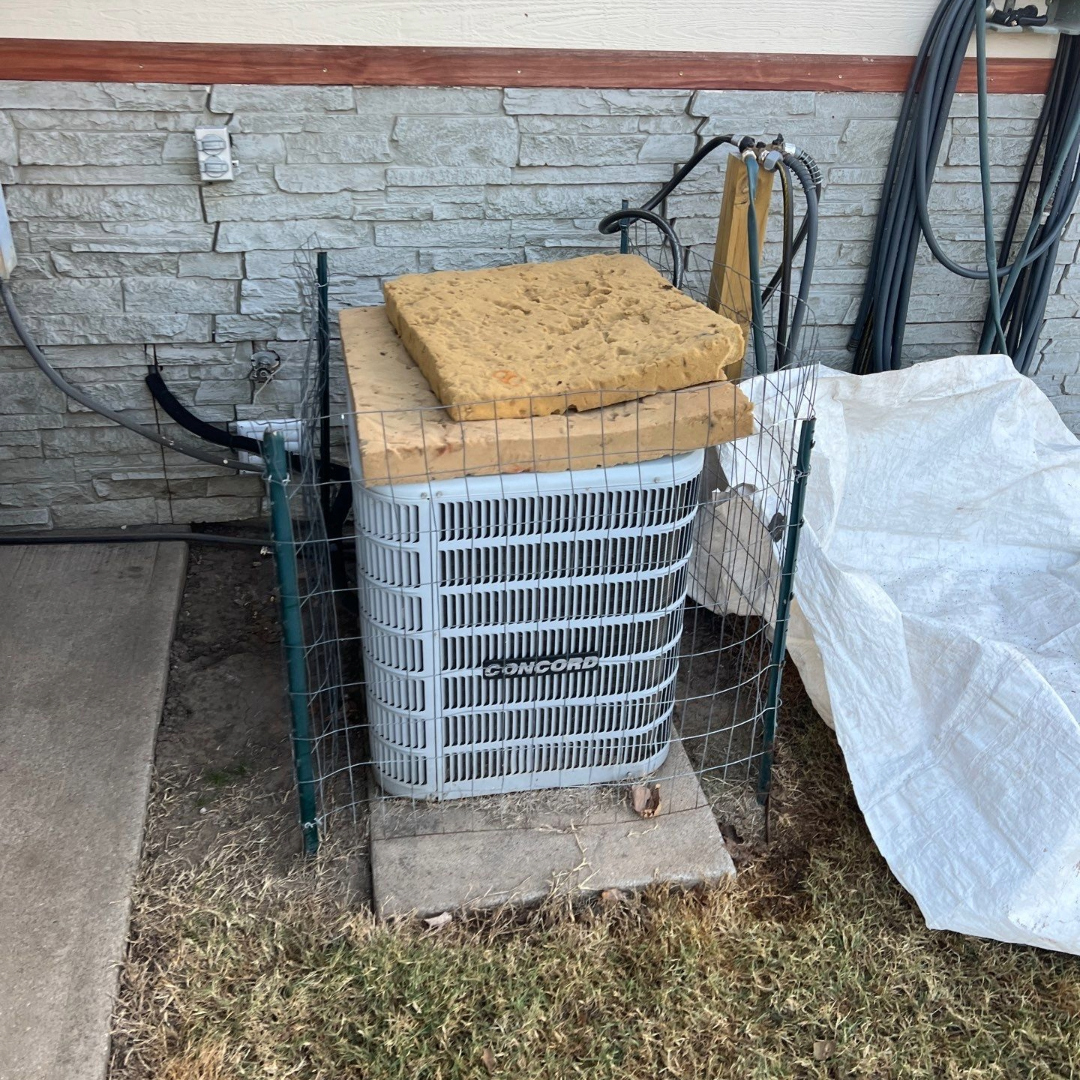
Foam insulation: This is often used to improve the crew’s traction while performing detail work (e.g., installing ridge caps on steep slopes or installing chimney flashing), but it also provides cloud-like cushion to vulnerable areas on the property. This is only used when the AC unit will not be in use.

OSB: OSB can be laid over the top of an AC unit for protection in cooler months. In summer, when the AC unit is likely to run, we often build an OSB “tent” that preserves airflow while deflecting debris to the ground. Tear-off on this multifamily property began in the fall.
Some vulnerabilities are obvious; others are unique to your property. We can identify obvious protection needs, but homeowners often have details we may miss during an inspection, like a loose fence panel, newly stained deck, irrigation heads, or a sentimental garden gnome inherited from grandparents. If something on the property deserves special attention, let us know so nothing is overlooked.
Why Preparation Matters
Cleanup quality is determined before the first shingle comes off. The more debris we keep off the ground entirely, the cleaner and safer the project becomes.
Another way of looking at it:
- If 80 percent of the debris never touches the ground, 80 percent of the debris doesn’t need to be cleaned up to begin with.
- If another 15-20 percent of the debris is caught by a mesh covering, then it can be cleaned up easily.
Thorough preparation makes our jobs easier and your property cleaner.
Once the roof is installed, the mess has already been managed. The crew will drop all debris collected by the Catch-All mesh system into the dump trailer and begin clearing any debris that was missed. When homeowners think of cleaning up the job site, this is what typically comes to mind. Because most of the debris never touches the ground, cleanup is closer to confirming that we prepared properly than correcting our mess.
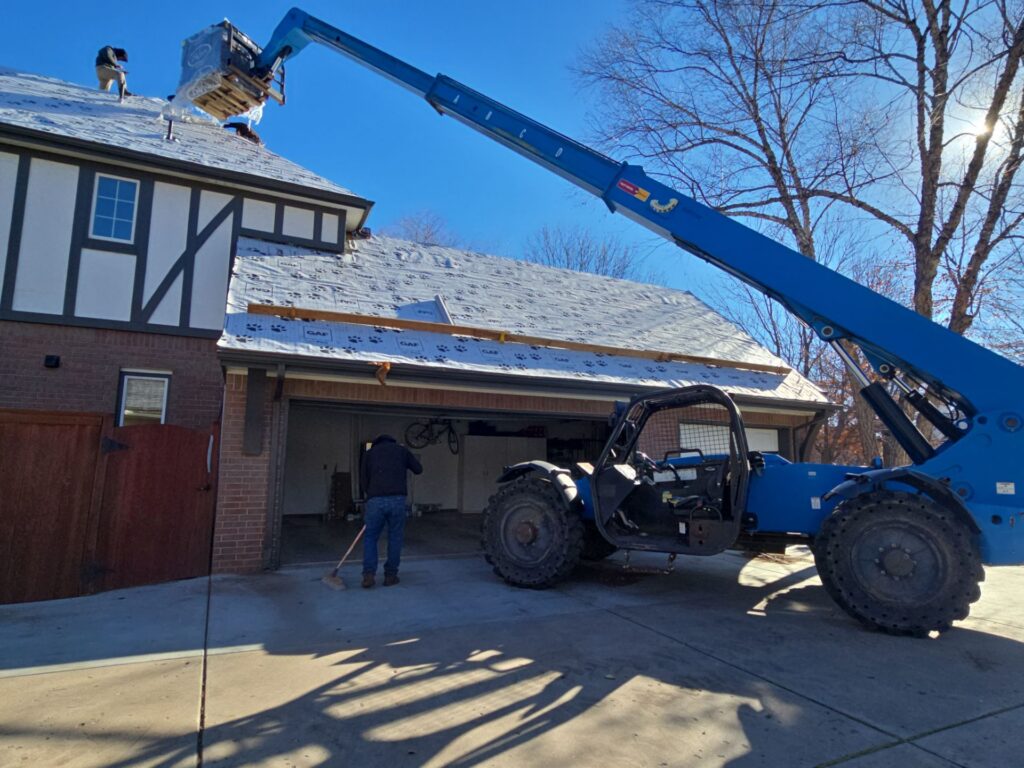
After tear-off was complete on this DaVinci roof, the crew cleared all debris from the property. The effectiveness of cleaning after a roof replacement if improved if cleaning begins during the roof replacement.
How Roofing Crews Clean Up During and After a Roof Replacement
Exclusively cleaning up after work is complete is like cramming before the final. When you’re tired and there’s a lot of work to do, that work can suffer. Cleaning up mid-day, or after tear-off, keeps the worksite safe, prevents debris from getting buried under new materials, and prevents the final cleanup from being a search-and-rescue mission for every nail.
When insurance covers a roof replacement, thorough cleanup is expected since it’s considered restoring the property to its pre-loss condition. Even when insurance isn’t involved, the standard is the same. We want you to be reminded of your new roof when you look up at it, not when you look down at a pile of nails.
How Roofers Clear Debris from the Roof and Gutters
Assuming your gutters remain on the house for the duration of the project, they will catch granules, nails, and even shingle bundle packaging. Anything large enough to pick up by hand is grabbed when the new roof is installed, while the remaining debris is blown off the roof with a gas-powered leaf blower. This prevents two problems:
- Rain runoff from washing an excessive amount of granules into the yard after the project. Combined with leaves, these granules can clog downspouts during the next rain.
- Nail accumulation at the end of the downspouts. The most common place to find nails after a roof replacement is at the end of the downspouts. Clearing the roof after installation is complete minimizes the number of nails that will wash down. However, even thorough cleanup may allow a few nails near the downspouts after rain: always check for nails near downspouts before mowing or letting kids or pets walk the property.
Using Magnet Rollers to Clear Debris from the Roof and Gutters
Protective equipment catches most of the 10,000 nails that come off the roof, but a few will slip through. The most reliable way to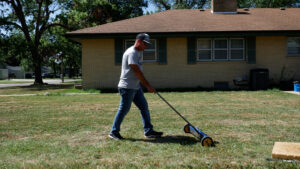 catch stray nails is with a magnet roller.
A magnet roller collects stray nails like a lint roller collects dust. The crew will sweep it over the yard, driveway, sidewalks, mulch/rock beds, and streets. Most of our roof replacements are completed in one day; however, multi-day projects will be magnet rolled at the end of each day to ensure the property is safe for vehicles, kids, and pets.
Clearing Catch-All Mesh Coverings and Tarps
Once the new roof is installed, the Catch-All mesh is carefully removed to contain any debris resting on top. The mesh is rolled from the outside in, almost like rolling a burrito. This prevents any debris trapped inside from spilling out, concentrating everything into a contained pile that is lifted and emptied directly into the dump trailer.
Final Inspection
After all work has been completed, a separate member of our team who was not involved in the installation often conducts a final inspection. During this inspection, they verify:
- All components are installed correctly.
- No debris remains in the landscaping, driveway, patios, or walkways.
- The roof systemRoof Types - A roof system (roof assembly) is the entire series of roofing layers and components above the roof deck that work together to weatherproof the building. More the crew installed is the system that was promised.
When preparation, protection, and process work together, cleanup is the final check that your home looks exactly as it did before, only with a new roof above it.
If you’re looking for a contractor that will protect your property while performing work on your roof, call Rhoden Roofing. The earlier you mention concerns you have, whether it’s a large pool or a small garden gnome, the earlier we can start planning your property’s protection methods.
Frequently Asked Questions (FAQ)
Where should I look for nails after my roof is replaced?
Even with thorough cleanup and preparation, nails may hide in places that naturally collect debris. The most common areas are:
- Near downspouts. After rain, nails can wash out of gutters and land directly under the downspout elbow – especially where the downspout drains in grass. Downspouts that channel water near driveways may channel nails into small cracks on the driveway or along the driveway edge in the grass.
- In mulch beds and rock beds, where nails can slip under mulch or between rocks. Mesh coverings will catch most of this debris, but gaps may still allow nails through.
- Underneath decks. Tongue-and-groove or composite decks with abutting boards keep nails on the deck’s surface where the magnet roller can collect them. Older wood decks with spaced boards, however, allow nails to fall between boards and collect underneath.
- Brick patios. Bricks and pavers have joints that act like tiny pockets for nails, even with strong cleanup and preparation.
- Leaf piles in the fall and winter. If leaves accumulate before or after your roof is replaced, you may find a handful of nails when raking. They’re usually caught by the magnet roller, but leaf piles are excellent hiding spots for any that escaped.
Are roofers liable for nails?
Yes, roofers are responsible for cleanup, including nails.
During a roof replacement, your contractor is creating the debris, so the responsibility to remove it also belongs to them.
That said, absolute perfection is rare. The real measure of accountability is whether the contractor returns promptly to correct any debris accumulation you find. Reputable contractors are prepared for a follow-up call and respond quickly.
Is it normal to see roofing nails in the attic?
Seeing roofing nails in the attic is normal under two circumstances:
- Your roof has plank or spaced decking instead of plywood.
- Some decking was replaced during your roof replacement.
Plank decking has small gaps between planks. If that gap is 1/8” or greater, solid sheathing, like OSB or plywood, will be laid over the plank decking. Large gaps may allow debris into the attic space before solid sheathing is installed. Similarly, if any decking is replaced during the re-roof, a small amount of debris may enter the attic space while it’s exposed.
In most cases, you will see the tip of some roofing nails through the roof deck. Nails are driven through the roof deck to secure the material to your roof, so this is normal – even expected.
Can you stay in your house while the roof is being replaced?
Yes, it’s safe to stay in your home during a roof replacement, but expect lots of noise, strong vibrations, and traffic outside of your home. There’s active construction overhead, and it will feel like it.
Some things to be aware of:
- Noise and vibration: Hammering can rattle wall décor, so remove any fragile items from the wall.
- Attic dust: Cover any valuable stored belongings to protect them from dust that will loosen from the rafters.
- Kids and pets: Your home’s exterior becomes a construction zone during a roof replacement and any fence gates will remain open.
- Yard preparation: Move vehicles and turn off sprinklers.
For a full preparation checklist, see How to Prepare Your Home for a Roof Replacement.