What is a Hot Roof System?
(Other Names include Unventilated Roof System, Closed Roof, and Spray Foam Roof Deck)
Most buildings with sloped roofs (as opposed to flat roofs) vent the underside of the roof deck to move heat and moisture up and out of the building. This is commonly paired with an open attic space, where the insulation for the building envelope sits on top of the ceiling of the top floor, and the rafter/truss space is empty above, all the way up to the roof deck. Intake ventilation at the soffits draws air in, while exhaust ventilation near the top (most common are box or ridge vents) lets air move up and out.
However, ventilation of the roof deck is not always possible, and may not be preferred. An unvented system applies insulation directly on the roof deck. Critically, they MUST be completely air impermeable, such as using closed-cell spray foam insulation, to a thickness where the inside surface will not be able to drop below the dew point and cause condensation even on the coldest day of the year. Insulation R-value requirements depend on climate zone: see below. Unvented roof systems are called “hot roofs” because they combine the roof system and insulation barrier into a single unit rather than two independent layers with moving air or an attic in between.
A full list of situations where a hot roof design may make sense is in the section below, but the applications largely boil down to two general categories: addressing limited space, and/or maximizing insulation value.
Note: for a complete list of the types of roof ventilation systems and how to identify them, see our article: What Type of Attic/Roof Ventilation System Do I Have? Note that many buildings have multiple ventilation system types; e.g. main house, a sun room or addition, detached garage, etc.
When Are Unvented and Hot Roof Systems Used?
A ‘hot roof’ design may be the best, or only viable solution in a variety of different situations. Broadly speaking, the use cases typically address either limited space constraints, the goal of maximizing insulation value, or both.
We have organized the list of unvented roof system applications from most common to least common. Especially in uncommon or niche scenarios, having this tool is essential to keep the building envelope safe/mold-free, and a relief to discover when so little information is available online or otherwise.
First, an aside about our use of the term “attic” within this article. In the field of building science, “attic” refers specifically to the unconditioned air cavity between the conditioned space and the roof deck. A true attic is a functioning part of the building system. If the top floor of a building has been converted to a conditioned living, storage, or mechanical space, it is no longer a true functioning attic, even if most people would continue to call it the “attic” in conversation (i.e., “attic bedroom”). In that example, the space behind the knee walls may still be a functioning attic, but it depends on insulation location and ventilation types.
- Vaulted/cathedral ceilings with trapped rafter bays or non-continuous bays. For example:
- Hip roofs where individual rafter bay do not connect to the upper ridge line for exhaust venting
- Sunroom roof that meets a headwall of 2nd story above
- Cathedral ceilings where individual rafter bays are interrupted by skylights
- Vaulted/cathedral ceilings in historic homes with shallow rafter bays: especially those built with 2×4 or 2×6 construction which are too small to accommodate both ventilation chutes, which are typically 2” thick, and insulation within the rafter bay.
- Small, unconnected roofs where traditional ventilation is unfeasible – e.g., bay window, dormers, bump-outs, cornice roofs.
- Homeowners attempting to maximize insulation R-value — especially with vaulted ceilings, largely because the closed-cell spray foam used to insulate has the highest R-value per inch.
- Roof areas over converted spaces, such as enclosing a former porch into conditioned space where the existing roof structure was not built with ventilation.
- Converting historic wood shake to modern roofing if adding intake/exhaust is not viable. Wood roofs are built on slatted decking and “breathe” throughout, whereas modern roofs use a solid, continuous roof deck and require either ventilation or a hot roof design.
- The lower section of multi-pitch roofs with limited access below – e.g. shallower first-floor roof that meets steeper 2nd-floor roofline.
- Roofs ending in a headwall at the top where exhaust vents are deemed unsightly. Most common examples:
- Headwall roofs on the street-facing side of a home
- Original rooflines on front of a house where back of house has had a 2nd-floor “pop up” addition
- Homes with multiple ridge/exhaust vent heights with a single, continuous attic space.
- Shed roofs (the architectural shape, as in single-slope, not storage sheds), especially with cathedral ceilings or steeper roof pitches where exhaust venting at the top is limited by lack of shared ridge/attic, and eave vents are impractical from exposure to precipitation in the wind.
- Buildings where intake venting is impractical or unwanted. Some examples include:
- Mid-century modern ranch and atomic ranch style homes from the 1950s & 60s with no eaves and on-roof intake vents are not wanted
- Homes with rafter-tail eaves rather than enclosed soffits and pocket vents or on-roof intake vents are deemed unsightly
- Buildings with highly decorative eaves, including certain Victorian, Italianate, Gothic, or traditional Chinese and Japanese architecture
- Geodesic dome or other uncommonly shaped rooflines, such as arched, catenary, or flared rooflines, butterfly roofs, or A-frame buildings.
Below are additional details on common scenarios cited above.
Vaulted Ceilings, or “Cathedral Ceilings”
Vaulted ceilings, also called cathedral ceilings, can either be vented or unvented; see our article What Type of Roof/Attic Ventilation System Do I Have.
Any vaulted ceiling with air-permeable insulation – such as fiberglass batts, net-and-blow insulation, open-cell foam, etc. – must have ventilation chutes or baffles against the roof deck to allow for adequate air flow. Those ventilation chutes must also be connected at the top and bottom to a functioning attic cavity or directly to exterior ventilation.
- At the bottom (intake), a connected attic space in the eave, or behind a knee wall usually meet this requirement.
- At the top (exhaust), each rafter bay can connect to a shared functioning attic space, such as a small triangular cavity at the ridge above a flat section of ceiling.
- Alternatively, each bay can connect directly to exhaust venting, such as continuous ridge venting, to allow airflow.
If any of the conditions for a vented cathedral ceiling cannot be met, then the solution may be to seal the space with air-impermeable insulation and use an unvented, hot roof design.
Unvented Roof: Case Study
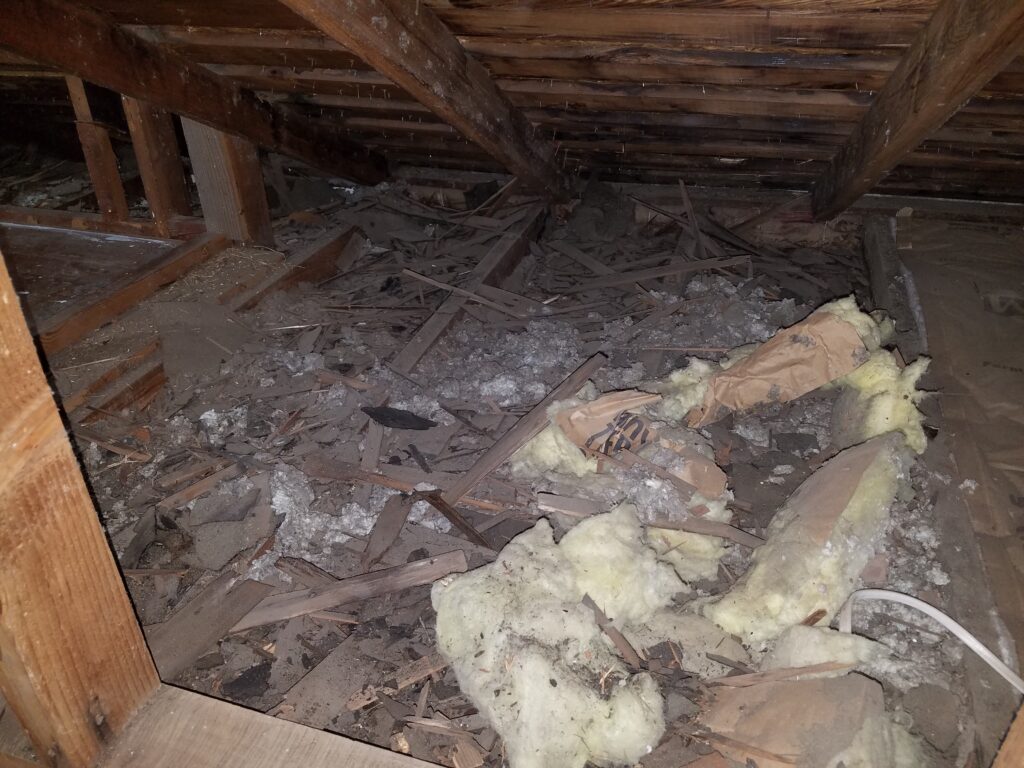
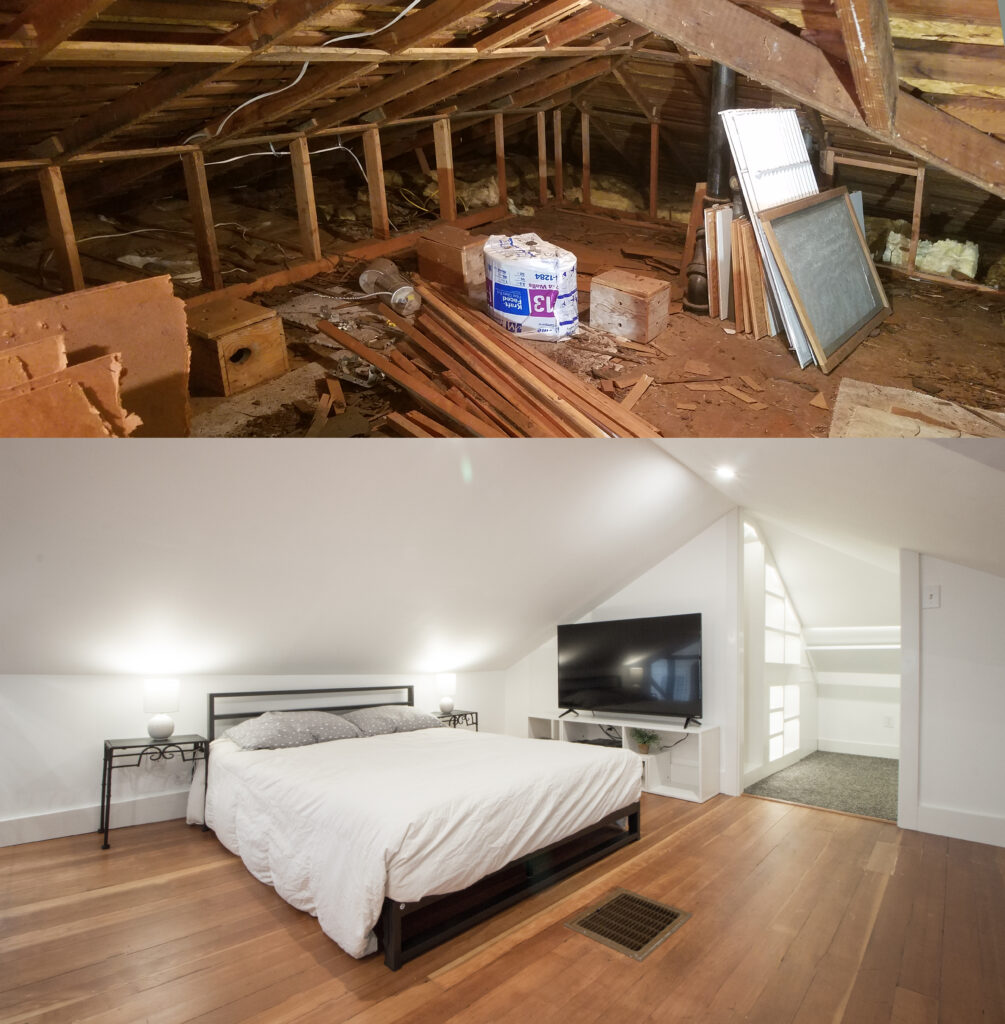
Figure 1: Rafters on this 1922 historic home are 2×4 construction, leaving little room for insulation without furring down the ceiling height. Additionally, roof hips and dormers close off rafter bays so that venting chutes would not be continuous from eave to ridge. Spaced plank decking is visible from the original wood shake roof, and much of the debris is still visible from when the wood roof was replaced with asphalt composite.
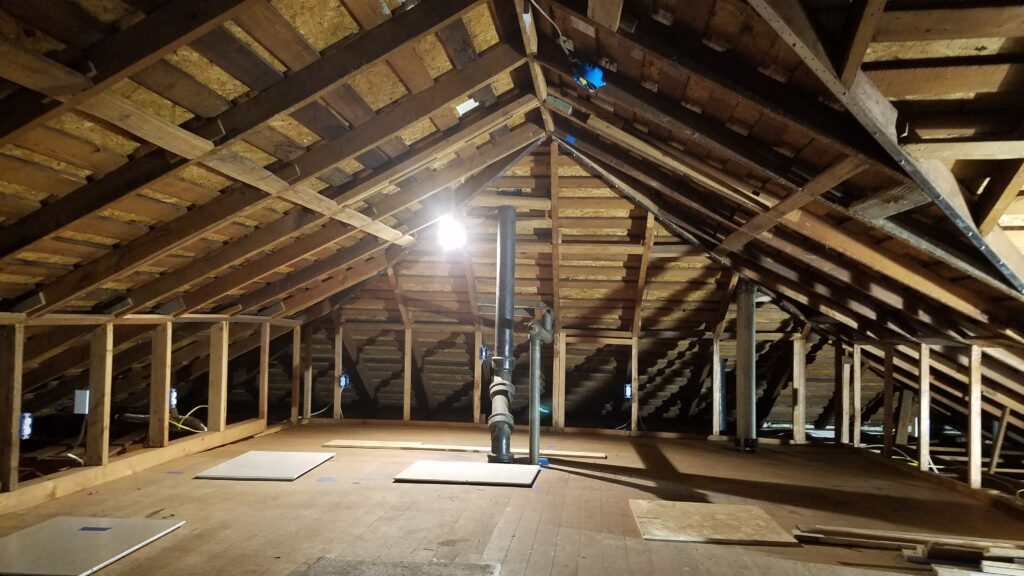
Figure 2: Eaves and rafter area cleaned out and prepared for closed-cell spray foam to enclose the air cavity and insulate. Spray foam functionally seals off any access to the rafter bay area, so electrical and any other chase items need to be run ahead of time before insulation.
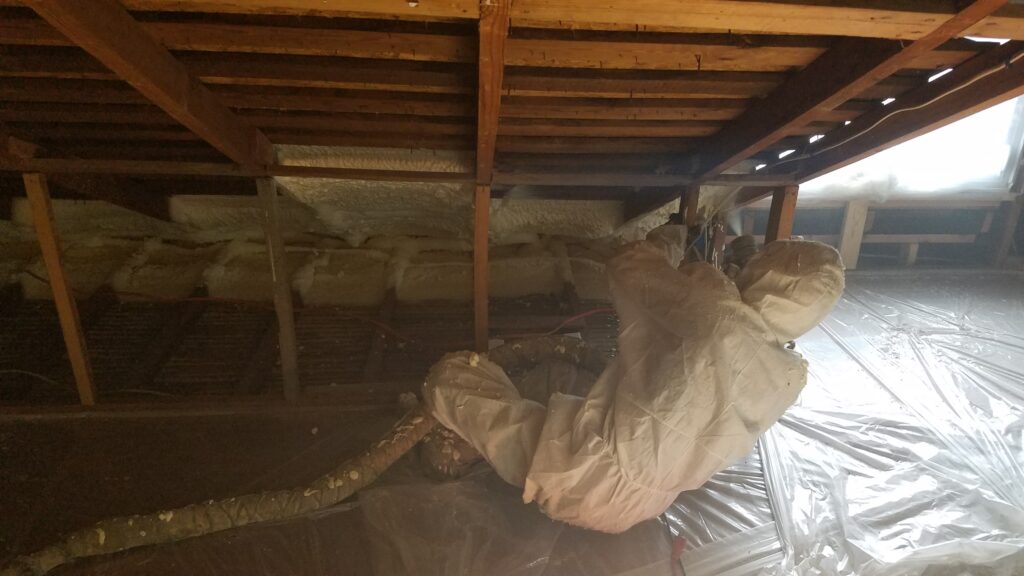
Figure 3: Joist bays over the eaves need to be insulated past the exterior wall below to the same spec as the roof, in order to enclose the insulation envelope of the building.
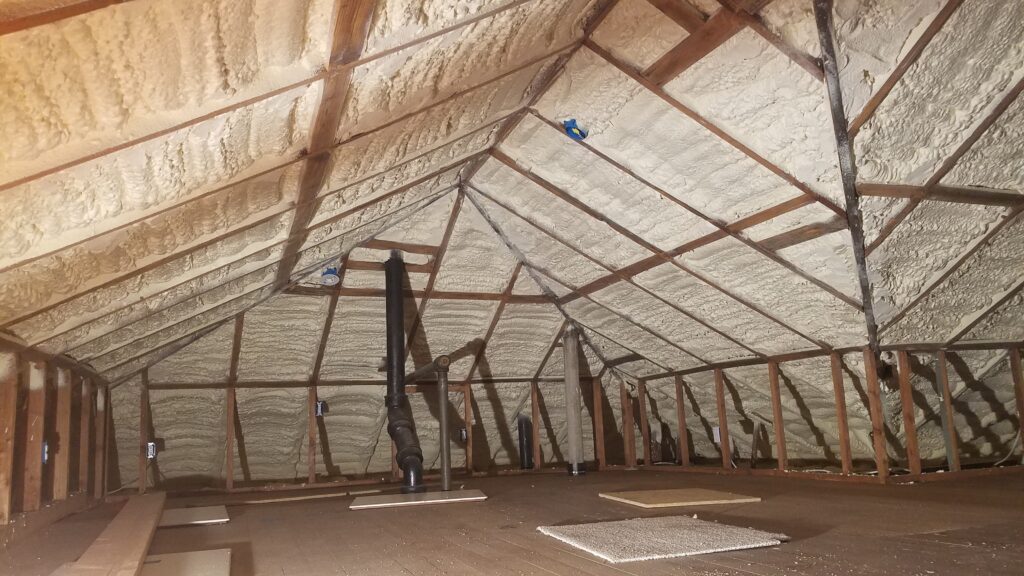
Figure 4: Spray foam in place against the deck and ready for drywall/finishing.
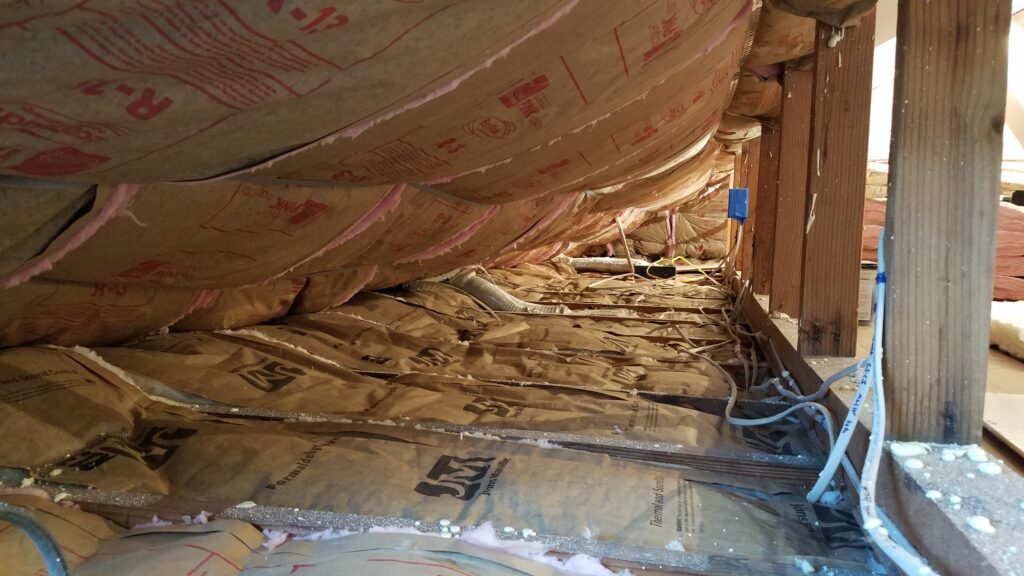
Figure 5: At a minimum, spray foam’s R-value must be high enough to prevent the area from reaching dew point to prevent mold from growing: wet and stagnant usually produces mold. However, more insulation can always be added. Behind the knee walls, for example, air-permeable insulation was added to supplement the R-value of the spray foam. Finally, bathroom vents from below were routed to the exterior of the building to export any humidity. Venting above the roofline would be preferred, but in this case the shallow roof pitch allowed venting through the soffit.
Drywall can’t fasten into rafters obstructed by insulation, so the spray foam was applied shallower in the finished area for ease of drywall work. In the unfinished eave area behind the knee wall, extra insulation can be applied.
Note that heat will build up in the enclosed attic space in the eave (behind the knee wall). Maximizing insulation in that area can prevent heat transfer through the ceiling below, and insulating the back of the knee walls themselves can transfer heat into the finished room.
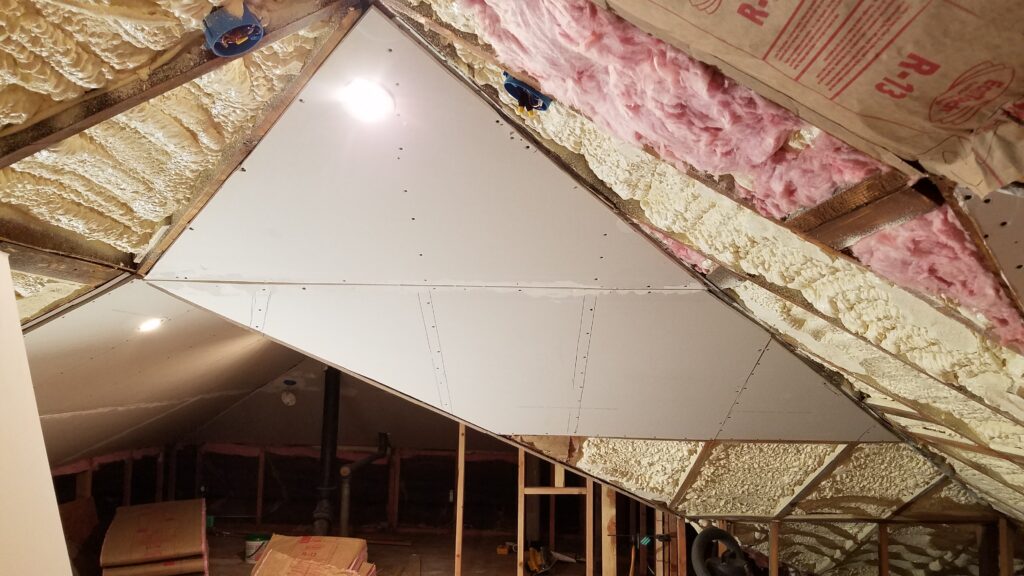
Figure 6: The small cavity between closed-cell foam and the back of the drywall can be filled with additional insulation (e.g., fiberglass, for sound attenuation and a little extra R-value). Closed-cell spray foam is rigid, so impact sounds (e.g., rain or tapping on the surface of a table) transfer clearly through it. Softer insulation is better at absorbing impact sounds. Roof systems are reasonably effective at attenuating ambient sounds (i.e., indirect sounds, like cars driving by), but not as effective at blocking impact sounds.
This is especially true for smooth, rigid roof materials like metal or composite tile.
How Are Unvented Roof Systems Built & Insulated?
Hot roofs have become more common in the last 20 years as closed-cell spray foam technology has improved and prices have become more affordable. The critical requirement for an unventilated hot roof system is getting air-impermeable insulation with an R-value that is sufficient to prevent the formation of any condensation on the bottom of the decking/insulation system, even on the coldest day of the year. In climate zone 4 (Southern Kansas and Missouri), this means a minimum of R-15. In climate zone 5 (Northern Kansas and Nebraska), this means a minimum of R-20. A higher R value is safer in case of inconsistencies in insulation thickness, wide variance of indoor humidity (which affects dew point), or extreme weather.
What Type of Insulation Is Used for Unvented Roofs?
The most common way to build a hot roof is with closed-cell spray foam (~R-6/inch) because of its air impermeability. The air-impermeable insulation layer must meet the R-value to prevent the inside face on the conditioned side from ever reaching the dew point. In the example where R-15 is needed, and using a spray foam rated at R6/inch, at least 2.5” minimum depth must be applied to the underside of the roof deck. Note that thermal bridging from rafters, nails, pipe penetrations, etc., will reduce the functional R-value at those points, so it is recommended to overshoot the minimum. Spray foam is expensive. Additionally, filling any thicker than the rafter opening adds labor cost (and mess) to shave down rigid foam before ceiling installation. Therefore, some people choose to apply 3” of depth with spray foam and then fill the remaining cavity space with compressible fiberglass batts.
In colder climates, such as the mountains or Northern parts of the US, some people use insulation in the roof deck system itself, such as rigid polyiso foam sandwiched between two layers of OSB.
It is also possible to design a hot roof with air-permeable insulation such as fiberglass batts or open-cell spray foam (which are cheaper), but it absolutely must have an air barrier like plastic sheeting to prevent condensation against cold roof decking or insulation. This somewhat riskier plan is more common in agricultural buildings or warehouses, where the cost savings over a large area are higher, or humidity/mold risk is lower – e.g., if industrial circulation fans constantly cycle air through the space. In an enclosed space such as above a vaulted drywall ceiling, the insulation must be air-impermeable.
Pros of Unvented Roof Systems
Why don’t all buildings use hot roofs? Conceptually, un-vented roof systems are the simplest insulation design: a single outer shell like an impermeable blanket on top of the building.
The “pros” from the detailed use case scenarios above can be summarized into:
- There’s not enough space/you can’t feasibly ventilate. Basically, unvented is your only option.
- Higher R-value of air-impermeable insulation can allow for better insulation in limited spaces.
Cons of Unvented Roof Systems
The “cons” list is longer. Each of these can be addressed, but you need to know what you’re doing to avoid surprises. In the right situation, hot roofs are the perfect solution. But here’s the precautions list; what to know about unvented roof systems and why they’re so much less common than vented roof systems:
- Risk of mold. Incorrect installation, trapping air pockets, or failure to achieve an air-impermeable barrier to beyond the dew point will lead to condensation, moisture, and mold growth.
- Cost. Spray foam is the most expensive insulation product available.
- Environmental concerns. While increased insulation is good for lowering heating/cooling demands, different spray foam manufacturers have widely different environmental impacts related to product sourcing, propellant, and off-gassing, which releases dangerous VOCs. This leads to some controversy about the use of insulation products on the market.
- Delayed discovery of roof leaks. Any material that is air-impermeable is also water-impermeable. Water leaking in through the roof surface may pool or get trapped/fail to dry out, leading to wood rotted decking or framing. Simply delaying how long it takes to notice roof leaks sounds like a good thing – the insulation will keep the water out of your finished ceiling, but there’s plenty above that subject to damage in the meantime. People with unvented roofs should be more diligent about inspecting their roof periodically or seasonally. Wet insulation also isn’t an effective insulator, effectively reducing its R-value.
- Minimal exterior noise reduction, especially with vaulted ceilings against the roof, or low ceilings closer to occupants. Spray foam is rigid and lightweight, which are the two things that transfer sound. Rain drops, falling leaves, and other impacts are particularly noticeable through rigid materials. Imagine tapping on a full can versus tapping on an empty can: which is louder? This is another reason some people choose to use spray foam to pass the dew point barrier, then fill the remaining cavity with cheaper, soft insulation such as fiberglass batts to add mass and absorb resonance.
- Difficulty repairing/replacing roof. If any decking needs to be removed during a future roofing project because of wood deterioration or direct damage, the spray foam will come out with it. That section requires the interior ceiling to be opened, re-sprayed, and drywall patched/textured/painted. If, for example, your home is positioned under a large cottonwood tree that likes to drop a big branch through your roof every few years, just know that those repairs will get a lot more expensive.
- Limited wiring/ceiling access. Anything enclosed in spray foam becomes completely encased. New wiring via fishing tape etc., is functionally impossible in a foam ceiling. Wiring or pipes can be chipped out if encased in spray foam, but only if that section of ceiling is removed. – e.g., wiring or pipes encased by spray foam can make future modifications a nightmare.
- Require intentionality with divided air pockets: e.g. eave area behind knee wall must be brought entirely within the insulation envelope (full roof deck plus soffit) if the ceiling/roofline above the knee wall is sealed.
A special note: Do not double insulate. We get customers who want to add insulation to their home to increase energy efficiency, and want to insulate the roof deck in addition to the ceiling above the top floor. Don’t do this. The building envelope – the boundary line between conditioned and unconditioned space – must be a single line. Double insulating traps air (and moisture) in between and becomes a breeding ground for mold and bacteria. This is like the Tupperware left at the back of the fridge. Don’t trap air.
Frequently Asked Questions (FAQ)
How common are unvented roof systems in Kansas?
Unvented roofs are relatively common for small roof sections, like bay windows or cornices. ~20% of homes have a small section of unvented roof. For larger areas, such as a whole slope, we only encounter it in about 5% of homes: usually newer custom builds or older (pre-1950) homes that have undergone major remodeling.
Is the roof built any different if the deck is insulated?
Other than the lack of ventilation components, no, the roof is installed the same way in an invented system.
Can you make just one section of a roof un-vented?
Yes – This is done sometimes with dormers that do not connect to primary ridges, or with individual rafter bays that are interrupted from bottom-to-top and block airflow, e.g. a skylight in a roof with a vaulted ceiling.