
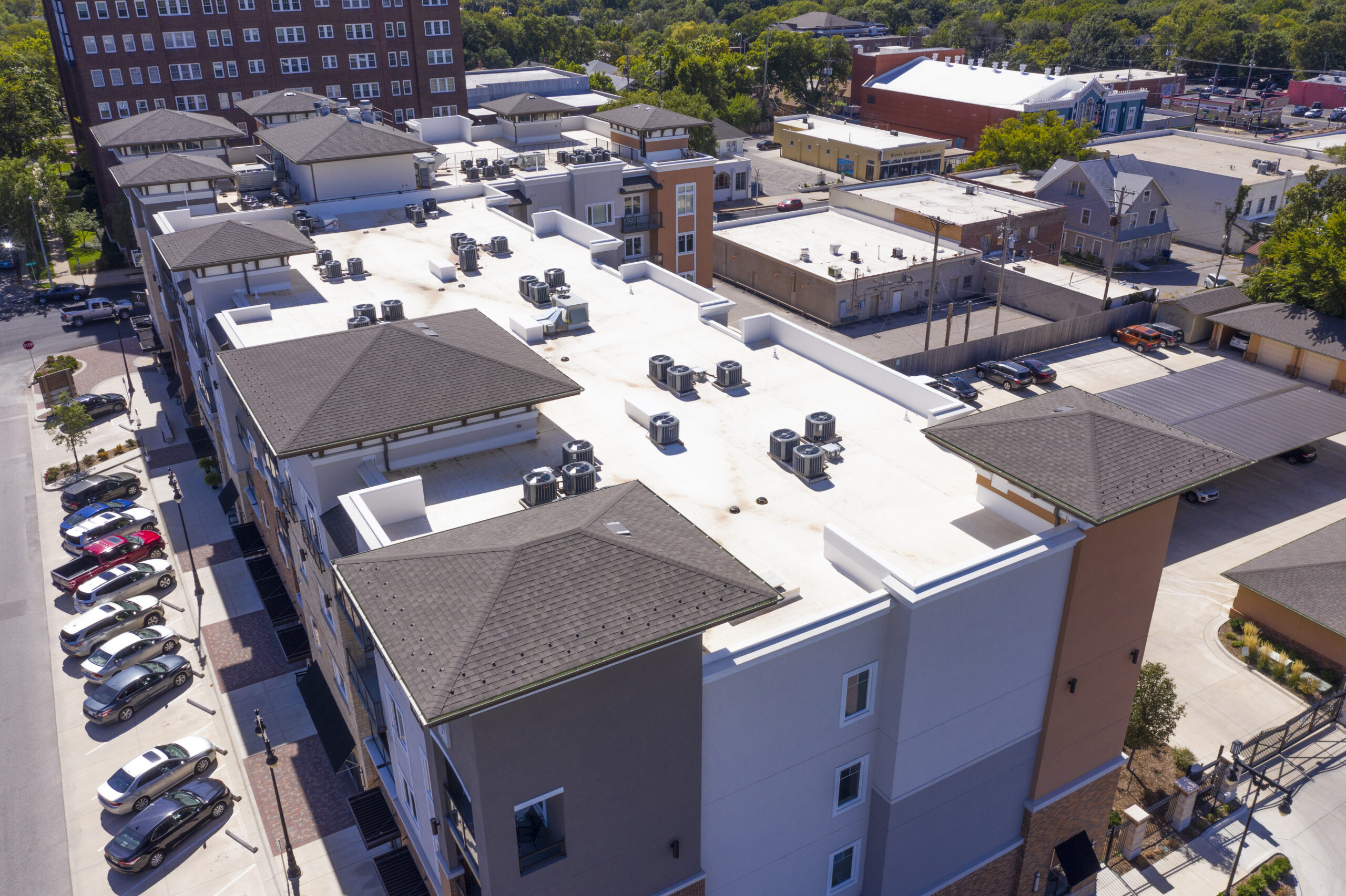
How Low-Slope Roofs Work
Low-slope roofs are most common on commercial and industrial buildings because their shallow pitch allows for large, structurally efficient roof spans and easier placement of mechanical equipment. Although they appear flat, they are built with a slight slope to direct water toward rains, scuppers, or gutters.
Unlike steep-slope roofs, which use gravity to shed water quickly, gravity acts slowly on low-slope roofs. They use continuous roof coverings designed to keep water out as it slowly drains from the surface. The key difference between the two roof systems is that steep slope roofs are designed to be water shedding, while low-slope roofs are designed to be waterproof.
Low-slope roofs also appear on some residential buildings, particularly contemporary home designs where a flat roof profile is part of the architecture.